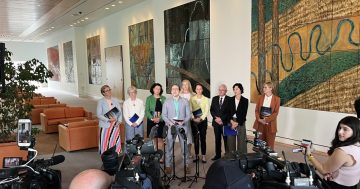
Ms Steggall reintroduced her Truth in Political Advertising Bill legislation with three major additions on 23 June. Photo: Screenshot.
Federal independent MP for Warringah Zali Steggall has renewed her push for truth in political advertising laws, with the tabling of a private member’s bill in parliament.
This is the second time Ms Steggall has introduced her Truth in Political Advertising Bill, saying it comes after what she claims is overwhelming public support for stronger protections against misleading political campaigns and the growing threat of AI-generated content and misinformation.
The new bill builds on truth in political advertising legislation Ms Steggall has previously introduced in parliament, the first in 2021.
Ms Steggall says trust in political institutions is declining, and that misinformation is increasingly infiltrating public debate.
She says her latest Commonwealth Electoral Amendment (Voter Protections in Political Advertising) Bill 2026 would combat this, establishing enforceable truth standards for political advertising and introducing Australia’s first national rules requiring the disclosure of deceptive AI-generated political content.
Ms Steggall has proposed three new reforms to add to her previous legislation.
These include the establishment of a Political Advertising Standards Board to oversee and enforce political advertising rules. The board would operate within the Australian Electoral Commission (AEC) but independent of its direction on substantive decisions, and would investigate complaints, monitor political advertising and publish rulings.
It would also have the power to order corrections, retractions, or the removal of unlawful advertisements. She proposes that non-complying ads would be subject to a financial penalty up to $300,000.
She also proposes that political advertising would be subject to a formal code of conduct requiring advertisements to be truthful, factually accurate and supported by reliable evidence.
It says ads could not mislead through omission, ambiguity or exaggeration, and opinions would need to be clearly identified as opinions rather than presented as facts. The code would also prohibit fake endorsements, false testimonials and disinformation campaigns.
The third new element is a mandatory disclosure of AI-generated content. Recognising the rapid rise of AI-generated content in political communication, the bill introduces clear disclosure requirements such as watermarks for AI-generated media, including deepfakes.
It says political ads containing digitally created or manipulated visual or audio content that is intended, or likely, to deceive a reasonable person into believing it is genuine would be required to display a prominent ‘AI-generated content’ label.
Ms Steggall said, if content was generated using AI in a way that could mislead voters, they had a right to know.
“As artificial intelligence becomes more powerful and accessible, the risks to our democracy are growing. Deepfakes and synthetic media can now be created quickly, cheaply and convincingly. Our electoral laws must keep pace,” she said.
In introducing her legislation, which was seconded by the independent MP for Bradfield Nicolette Boele, Ms Steggall said for too long major parties “have used the lack of political advertising regulation to mislead and deceive voters”.
“This bill is about a simple principle,” she said. “Protecting voter rights from scams, the same way we protect consumer rights.
“The major parties have refused to do this for too long now. Why I would say can be obvious.
“But with the rise of the far-right movement and post-truth politics, supercharged by AI and social media platforms, this is only going to get worse and absolutely must be addressed without any further delay.
“We have longstanding consumer protections to protect people from being scammed out of their money by misleading and deceptive advertising for goods and services,” she added.
“Yet we continue to allow voters to be scammed by misleading and deceptive political advertising. We allow different rules for politicians and the rest of Australians, and it has to stop.”
In seconding Ms Steggall’s motion, Ms Boele said a strong democracy needed a firm foundation of evidence and honesty.
“So it’s for that reason it’s a privilege to be speaking today on the need to have truth in political advertising to improve transparency and ban the lies,” she said.
“It’s shocking that as a politician, I could run ads tomorrow that have no bearing to the truth and face next to no consequences. It just doesn’t make sense.”
Director of The Australia Institute’s Democracy & Accountability Program, Bill Browne said, “Political advertisements that are deceptive and misleading interfere with the public’s ability to make informed decisions.
“Without action, we risk election campaigns sliding into a free fall of fake news.”