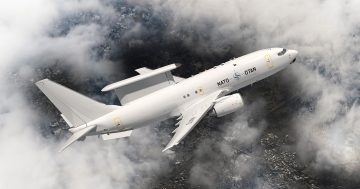
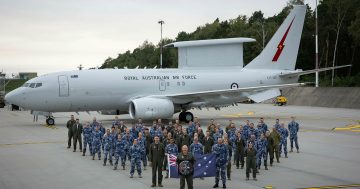
Concept art of a US Air Force E-7A. Image: Boeing.
Just 12 months after the Pentagon appeared ready to walk away from crewed airborne early warning aircraft in favour of a space-based system, it has reversed course and will now fund the first seven of up to 26 Boeing E-7A Wedgetail aircraft for the US Air Force.
The E-7A Wedgetail is based on commercial Boeing 737-700 and features an advanced mission system, ‘surfboard’ style radar on the upper fuselage, and advanced electronic support measures. Australia was the lead customer for the E-7A, and is currently the largest operator with six aircraft.
Royal Australian Air Force E-7As have seen service in the Middle East in the war against ISIS, in eastern Europe protecting NATO and Ukrainian airspace from Russian incursions, and again now in the UAE defending against Iranian missile and drone attacks.
The US had originally planned to acquire the E-7A to replace its 24 ageing E-3G AWACS – one of which was destroyed on the ground in Saudi Arabia on 27 March in an Iranian drone strike. Based on Boeing’s 707 airframe which ended production in 1991, the E-3s have received several upgrades over their service lives but are all more than 40 years old.
In 2024, Boeing won a US$2.5 billion contract to manufacture two E-7 prototypes, but at the start of the second Trump administration, elements within the Pentagon suggested the E-3s could be replaced by satellites even though a satellite system capable of performing the Airborne Moving Target Indicator (AMTI) mission does not yet exist and will likely not be in place for at least a decade.
In response to the E-7’s cancellation, six former US Air Force Chiefs of Staff and nine retired generals lobbied Congress to reverse the decision, so $1.1 billion was invested to complete the two prototypes.
The E-7 is in service with Australia, South Korea, and Turkey, and will soon enter service with the UK, and little development is required for it to be suitable for the US. Plus, the urgency of an E-3 replacement has only been heightened by the loss of the aircraft in Saudi Arabia.

The GlobalEye is based on a Bombardier 6500 business jet airframe and a Saab Erieye radar and mission system. Photo: SAAB.
“There are gaps that still need to be filled, and there are systems that still need to be funded that are used on the battlefield right now … the E-7 is one of those,” US Defense Secretary Pete Hegseth told the House Appropriations Committee earlier this month.
“So, we’ve actually sent a budget amendment to OMB [the White House Office of Management and Budget] to add that, and I think it has a future. It has a place on the battlefield …”
The North Atlantic Treaty Organisation (NATO) – of which the US is a member – also operates a number of E-3 AWACS and has a similar pressing need to replace these aircraft. Despite originally selecting the E-7 in November 2023, it has now reversed course and has selected a system from Sweden and Canada.
US publication DefenseNews reports the E-7 was selected by NATO without a competitive tender and before Saab could submit its own offer for its GlobalEye. The GlobalEye is based on a Bombardier 6500 business jet airframe and a Saab Erieye-ER radar and mission system.
DefenseNews says the US’s change of mind on the E-7 as well as political doubts over the US’s ongoing commitment to NATO prompted it to reconsider Saab’s offering. In November 2025 the NATO consortium led by the Netherlands scrapped the E-7 buy, with Dutch State Secretary for Defense Gijs Tuinman highlighting “the importance of investing as much as possible in European industry”.
The NATO Support and Procurement Agency (NSPA) is believed to have a requirement for between 10 and 12 aircraft, with the selection of an initial buy of four GlobalEyes by France to replace its own E-3Fs likely also influencing NATO’s selection.
DefenseNews also reports that Canada, Germany and Poland are considering the GlobalEye for their own requirements, and that Saab says it can deliver operational systems to NATO by 2031.