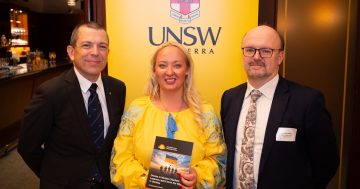
UNSW Canberra Pro Vice Chancellor of Precincts Professor Zoe Terpening and General Manager Luke Garner in the ProtoHub. Photos: Ian Bushnell.
In a former CIT workspace from another era some of Australia’s most cutting-edge innovation is now taking place.
A month ago UNSW Canberra occupied some of the spaces at the former CIT Reid buildings while across the road on what were carparks its new campus is under construction and soon to start rising from the dirt.
The innovation precinct is a model UNSW has pioneered successfully elsewhere, bringing researchers and industry together to take ideas through prototyping and testing, and then onto market.
UNSW Canberra has set up its ProtoHub in a building on Constitution Avenue. It is a high-tech facility and a Canberra first that gives local businesses access to advanced machinery and technology to develop their ideas into working prototypes.
It has also established in a former basketball hall a robotics testing facility.
The Large-scale Indoor Robotics Test Arena (LIRTA) is the largest in Australia and researchers and industry partners are developing the next generation of drones, robotics, autonomous systems, and AI technologies.
Pro Vice Chancellor of Precincts Zoe Terpening said UNSW Canberra was keen to let the community know that while the campus development was exciting the university was already on site.
Professor Terpening said it was no coincidence the ProtoHub was visible from the street.
“Now can you imagine a young child walking along here. To hide this in the inner core of this campus would be a missed opportunity to inspire the next generation of entrepreneurs and startups that might come to a space like this,” she said.
Professor Terpening said the focus was on creating ecosystems not siloed work spaces, and that included Year 11 and 12 students studying cybersecurity and young engineers who might then enrol with UNSW Canberra.
She said there were about 14 or 15 industry partners that had co-located at Reid and another site on Northbourne Avenue, and there were another 14 or 15 that UNSW was working with to co-design the types of spaces now operating at Reid.
“So it’s not simply a site for the university, it’s a commitment by the university to understand its ecosystem and its partners and to respond to those needs, to generate jobs, to generate a nice place for the community to be, and specialised facilities,” she said.
UNSW Canberra General Manager Luke Garner said the university was investing in the full innovation pipeline from ideation all the way through to advanced manufacturing to support the industries of Canberra, and attract more innovators to the national capital.

Professor Matt Garratt says drones can do work that is “dangerous, dull and dirty”.
Mr Garner said the new co-designed spaces were also proving grounds for future operations and the kinds of facilities that would emerge in the new campus buildings. ProtoHub engineering manager Matt Barrett said a shared, collaborative facility reduced the capital costs of taking things through the innovation life cycle as well as hastening their progress.
He said the ProtoHub had a range of capabilities, from plastics to electronics, including devices and printed circuit boards (PCBs), to 3-D printing, as well as automated robotic machines to take a product to the next level.
“Co-hosting students and industry together really creates better graduate outcomes,” Mr Barrett said.
He said many industry partners were in the military and security space so it was important that Australia retained these innovative breakthroughs.
“We take everything from first year, particularly in engineering and computer science students, where they can come and do those introductory engineering courses in the ProtoHub right through to when they’re in their final year, where they can actually do industry projects in partnership with our collaborators, and start working on those technologies as they transition into the workforce,” Mr Barrett said.
“It has a huge benefit to our students.”
The facility hosted everything from startups to SMEs. “We can incubate their product, help them with the design and the scaling essentially,” Mr Barrett said.
This type of arrangement had already produced tangible results. Mr Garner said the most prominent was the phenomenal success of Skycraft, which built and launched satellites to track global aircraft movement.
“Everything is here, you can build the chassis, the electronics within it, the whole kit and caboodle for them to be able to prototype, and then send it up to space to test and make sure that technology’s there,” he said.
“And it’s a hugely successful Canberra company. They’ve raised $125 million in capital, and they’re all located here, doing that R&D with the university.”
Where basketballs once bounced and flew, drones are buzzing and flapping as robotic dogs scamper around the floor.


Professor Matt Garratt is in charge of the robot test arena, where drones can be flown safely and without restriction 24/7.
They and the robot dog had applications in the military, agriculture, emergency response, infrastructure inspection, search and rescue and disaster response, such as in bushfires, where the work was “dangerous, dull and dirty” and they can get to places humans can’t.
“It’s very important that Australia is at that cutting edge of technologies based on drones and autonomy,” Professor Garratt said.
“We really do hope that that investment increases exponentially because we need to be at that point where we can have our own solving capabilities in terms of robotics and AI and also national disaster response.”
At present, LIRTA was working with novel flapping wing vehicles, modelled on birds and dragonflies, which at small scale were more efficient than a drone and used a lot less power.
“We’re at the stage we can control them, and we have AI powered algorithms that actually allow them to learn and adapt to their environment,” Professor Garratt said.
Accompanying the large flying zone is electronic equipment to track robot movement and prove how well the algorithms they use are working.
The larger facility allows for testing drone swarms with precision and accuracy, down to the centimetre.
Professor Garratt said the step from the robot dog to humanoid form, such as what was happening in China, was not that great.
“We would be very interested in actually doing that soon, because the cost of humanoid robots has come down significantly. They’re actually quite cheap now,” he said.
Mr Garner said the university wanted to fill the skills gap in Canberra and in 2028, when the Stage 1 of the new campus was expected to be completed, would release more programs that spoke to the university’s strengths in technology, engineering, and AI.
He said UNSW Canberra had already invested $5 million in local businesses, partnering with the ACT Government through Activate Canberra.
Canberra also had advantages that no other jurisdictions had.
“Canberra is the highest educated population in Australia and it produces more patents, and what we’re wanting to do is help people with those ideas and get them into commercial products,” he said.
“It’s a very unique physical position. Being within the defence corridor and co-located with key government and other partners, gives us an opportunity to do something in this ecosystem that we couldn’t do elsewhere.”
The development of the new campus is a 10- to 15-year project over four stages. Stage 1 will comprise two interconnected buildings accommodating about 19,300 square metres of space.
It is expected to be completed in the first half of 2028, with the next stage to follow a year or so after. Eventually, the new campus will cater to 6000 students and transform the eastern end of the city.
The ACT Government provided the 8 ha of land at a peppercorn lease and agreed to spend $25 million with the university throughout its development.
Mr Garner said the Chief Minister understood the value of higher education in Canberra, “but beyond just providing education, it’s that research and the way in which we can leverage industry” that were important.
Original Article published by Ian Bushnell on Region Canberra.