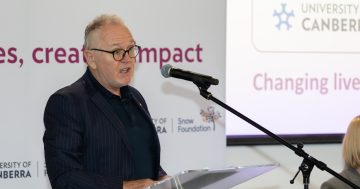
Australia’s universities should be given legally protected autonomy, says the sector’s peak body. Photo: UC.
The autonomy of Australia’s universities should be enshrined in federal law to better protect higher education’s future and the nation’s democracy, says the sector’s peak body.
Universities Australia chair Carolyn Evans will use her address to the National Press Club in Canberra today (26 August) to call on the Federal Government to consider legislative protection for university autonomy.
She warns that the accumulation of regulation, new federal bureaucracies and greater central direction is narrowing the space for universities to make independent decisions.
While there is a legitimate role for regulation and accountability, she says the nation needs a clearer debate about where government oversight ends and institutional autonomy begins.
Professor Evans says university autonomy is vital to the sector’s future and it must be made clear what it is that governments cannot and should not interfere with to help universities stem the tide of government overreach.
“When governments seek to regulate our media, the democratic threat is recognised, and so questions are asked and debated as they should be. The same is not true for universities,” Professor Evans will tell the Press Club.
“Every time government sets out to regulate or, indeed, informally push universities in particular directions, they do so for a good reason.
“Indeed, many inside universities and university unions are often – misguidedly in my opinion – encouraging them to do more.
“But the creeping regulation over years, the creation of new federal bureaucracies seeking to impose their agendas and their judgment on our work, the populist backlashes from the left and right when they don’t like something we do – all this is creating an ever narrower space for freedom of both institutions and individual faculty and students.
“The cumulative cost of this approach needs tallying, and there needs to be a reckoning.”
Professor Evans acknowledges that if Australia’s 40-plus universities are given such freedom, mistakes will be made.
She says “every single one of them” will get something wrong and try something that fails.
Some will predict a future need inaccurately, but the immediate solution should not be more government intervention.
On the flip side, some universities will try something innovative that “succeeds beyond all expectations”.
“Some will spot coming employment needs that everyone else misses and cater to them, some will pioneer new forms of teaching, create new knowledge and research breakthroughs,” Professor Evans will say.
“If, however, you try to control too much from the centre and the government or ATEC (Australian Tertiary Education Commission) gets it wrong, then every single university will make the same mistake.”
Professor Evans will also argue that governments have spent decades reducing public funding and encouraging universities to generate other revenue, only to now criticise the sector for relying on international education.
She will observe that government itself is becoming increasingly reliant on international student revenue through sharply higher visa charges, while warning universities about the risks of the same reliance.
“A lot of public discourse likes to describe this as universities being greedy, risky, and addicted to international student funding,” she will say.
“We are, in truth, forced by government policy to be reliant on it.
“The reality is that the Australian taxpayer got a world-class university system at a cut price and the Treasury – and the taxpaying public – got the benefit.
“With the egregious increases in the cost of student visas and post-study work rights visas in recent years, the government is becoming reliant on international student income, despite warning universities of the risks of such reliance.”
Professor Evans will ask policymakers advocating for significant cuts to explain what their plan is for the consequences.
What will be the consequences for university finances; jobs and smaller campuses; health and aged care; tourism; Australia’s regional relationships and economic growth?
“As a society we need to be able to look at the full consequences of policy decisions and not just become distracted by the theatrics of politics,” she will say.
“The most pressing example here for our sector – but by no means the only one – is international students as an element of migration policy.
“There may be good reasons for reducing the number of international students, or indeed other migrant groups, but we need an honest and informed policy debate about the consequences.
“Over decades, both sides of politics have reduced public funding for universities, shifting some of the costs to Australian students while capping the amount they can be charged and thus leaving a large gap in university budgets.
“Universities were sent out into the world to find additional funding to fill that gap, to ensure that we could cross-subsidise to deliver low enrolment but important courses for Australian students; cover the full cost of research, including on costs; invest in critical infrastructure (both physical and digital); and deal with the ever-increasing cost of compliance.
“Many people think that because we are called public universities, governments pay for all those things.
“They do not, they do not pay for any of them, and they show no interest in doing so.
“Generating revenue from international students was the only realistic solution.”
Original Article published by Chris Johnson on Region Canberra.