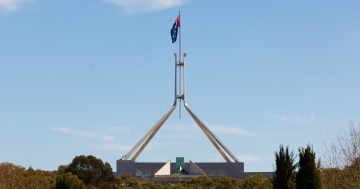
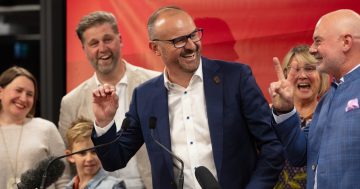
The Grattan Institute says Federal Parliament should step in to reduce political campaign spending. Photo: John Lomnicki.
Federal Parliament should pass laws to significantly reduce the cap on political campaign spending to improve Australia’s democracy, says think tank the Grattan Institute.
The institute’s latest policy briefing, Decoupling money from power, describes an election-spending “arms race” that only benefits the major parties.
It says the $90 million political party spending cap that will kick in next year is far too high and should be reduced to $40 million.
But allowances for individual candidates should be adjusted so they don’t disadvantage independents and newcomers.
“New caps on electoral spending will apply from next year, but there are substantial problems with the Federal Government’s new caps,” the Grattan Institute’s Kate Griffiths said.
“The new caps leave too much money in politics, and advantage the major parties over new candidates.
“The new national cap of $90 million per party per year finally puts a ceiling on money in our politics – but the ceiling is set too high.”
The policy brief says $90 million is far more than national advertising campaigns cost. However, the cap would still allow sufficient funds to communicate with voters nationally while reducing the corrosive influence of money in politics.
“On the other hand, the government’s new individual electorate cap of $800,000 is too low for new entrants, who usually need to spend more to introduce themselves to voters,” Ms Griffiths said.
“Successful new entrants at the past three federal elections have on average spent $1.5 million on their first successful campaign.
“Right-sizing the new expenditure caps would finally put an end to the election-spending arms race and decouple money from power in Australian elections.”
The policy brief recommends keeping the electorate cap at $800,000 for incumbents and established-party candidates, but raising it to $1.2 million for new independents and new parties.
It says the Federal Government’s reforms are a step in the right direction, but the parliament should “step in” to finish the job.
“There’s too much money in Australian politics. Political parties collectively declared almost half a billion dollars in expenditure in the year leading up to the 2025 federal election,” the policy briefing states.
“And this was not a one-off. They declared expenditure of more than $400 million in the lead-up to both the 2022 and 2019 federal elections as well.
“There are strong electoral incentives for political parties to try to outspend their opponents.
“More often than not, the party that spends more wins. This creates an ‘arms race’ – a competitive escalation of election spending, particularly between the major parties, and an equivalent escalation in fundraising efforts to support it.”
The Grattan Institute says electoral expenditure helps to inform voters, but only up to a point, with negative attack ads and political ads thin on factual content doing little to enhance democracy or meaningfully inform voters.
Meanwhile, more spending means more fundraising, which can involve selling access to donors and can increase the risk of dependency on major donors.
“Politicians’ attendance at fundraising dinners and donor events can also erode public trust. Political parties appear to rely on just a handful of major donors to fund a substantial share of their campaigns,” the briefing paper states
“Top 20 donors represented 75 per cent of declared donations to parties in the lead-up to the 2025 federal election, 86 per cent in 2022, and 89 per cent in 2019.
“Donations build relationships and a sense of reciprocity, so there’s an increased risk of corruption and a real risk of major donors having outsized influence in policy-making.”
It says that while explicit corruption is rare in Australia, there are more subtle risks, including donors getting more access to policymakers and their views being given more weight.
The policy paper makes eight recommendations.
- Lower the total electoral expenditure cap (the federal cap) for political parties from $90 million to $40 million
- Add a 50 per cent loading to the individual electorate cap (the divisional cap) for new entrants
- Return public funding for election campaigns to previous levels (back to $3.50 per vote from the increased $5 per vote)
- Leave the Senate caps as is, but consider introducing a minimum floor
- Reduce the third-party cap from $11.25 million to $5 million, proportional to the reduction in the total cap
- Close the loophole in the donation cap that advantages major parties by allowing the cap to apply separately to each registered branch of a party
- Strengthen oversight of taxpayer-funded advertising to prevent politicisation, particularly in the lead-up to elections, and
- After each election, have an independent expert review to reassess the size and structure of the caps.
“Capping electoral expenditure puts a ceiling on money in politics and, if well-designed, can reduce its influence,” Ms Griffiths said.
The paper is unlikely to gain traction with the government or Opposition, who are content with the incoming new caps and arrangements.
But most independents and some minor parties agree with the Grattan Institute’s recommendations.
Original Article published by Chris Johnson on Region Canberra.