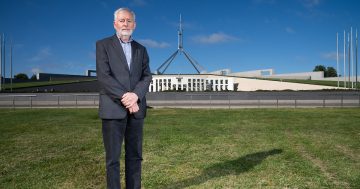

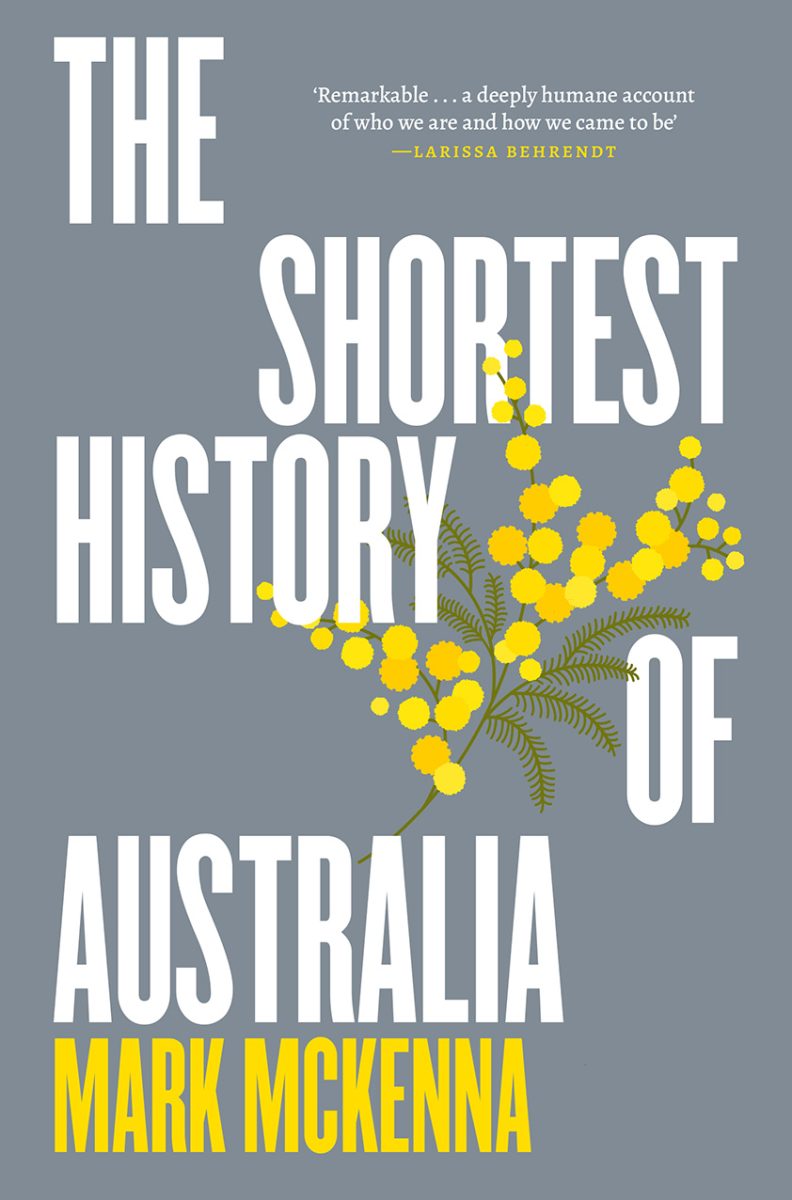
Mark McKenna offers a compelling new version of our national story in The Shortest History of Australia. Photo: Supplied.
Historical revisionism leads to divergent interpretations, and sometimes they are one-of-a-kind. The Shortest History of Australia is in a class by itself. An engrossing read, this fresh edition of our national story triggers a deep interest in and an inquisitiveness about its contents.
The key theme is Australia’s intricate national identity and history, and one of this country’s leading historians, the University of Sydney-based Mark McKenna, presents a persuasive new version.
His publisher, Black Inc, says this is a modern Australia permeated by First Nations history; a multicultural society with an island mindset; a continent of epic beauty and extreme natural events; a country obsessed by war abroad but blind to its founding war at home; and a thriving nation-state still to realise its political independence.
Emeritus Professor McKenna acknowledges that if he was going to bring another history into the world, it had to offer something new since many excellent histories of Australia have already been published.
“I wanted to write a history that was different in its approach and emphasis, one that would spark interest in Australian history, not only for Australians but for overseas readers as well,” he writes.
“There was no point in writing another chronological history. In the end, I decided to say more about some things rather than a little about many things.”
Much of McKenna’s writing over the past 25 years has sought to reveal the connections between the histories of places and the larger narratives of nationhood. This is the perspective to this book.
“I’m always struck by the richness and variety of Australian history, especially its Indigenous histories, which I’ve included in every chapter of this book. This seemed all the more important after the failure of the 2023 referendum, which rejected the proposal to recognise First Nations Australians in the constitution by establishing an Indigenous Voice to Parliament.”
McKenna’s history is a benevolent account, perceptive, with integrity and wisdom. He supplies a foundation, reveals the unexpected through common experiences, all the while recontextualising the past to gain greater clarity.
As the country is an integral part of the people’s identity, The Shortest History of Australia examines the friction between lingering difficulties and the resilience that persists. Intertwined are the historical narratives that considerately built the nation, embodying the essence of Australia.
Structured thematically, Australia’s past, present and future receive thoughtful evaluation, being created with purposeful precision. It’s empathetic and embraces life’s journey with a positive perspective.
The opening chapter is where we read of ‘’The Founding Lie’’ and learn more about how “no other building telescopes Australia’s past, present and future like the Sydney Opera House”. We are also told that “… much of the continent’s 65,000 years of human habitation is yet to be understood.”
Among other subjects, distinctive features of Australian politics are synthesised from a variety of standpoints, along with the rise of environmental consciousness.
Multidimensional in its approach, it draws attention to many fascinating connections, such as “prophets coming from the suburbs. Two of the political leaders — John Howard and Paul Keating — who shaped Australia profoundly over the last three decades grew up within 10 kilometres of one another in the southwestern suburbs of postwar Sydney.
“Aside from the glaring religious and political differences, these origin stories had much in common: respect for hard-working people, disdain for social ‘airs and graces’ and a commitment to serve the community through politics and public life …”
Their political careers celebrated Australia’s suburban ideal — otherwise known as the ‘’great Australian dream’’: a home of one’s own.
“Today, 70 per cent of Australians live in the suburbs. This is where the daily reality of the country’s multicultural society is lived out.
“For all the achievements and failures of Australian governments over the past half-century, after the day-to-day noise of their time in office subsides, the things they are remembered for — the larger, transformative policies that endure in the popular imagination — come down to a handful of signature reforms.”
McKenna is the author of several prize-winning books, including From the Edge: Australia’s Lost Histories, Looking for Blackfellas’ Point and An Eye for Eternity: The Life of Manning Clark, which won the Prime Minister’s Literary Award for non-fiction and the Victorian, NSW, Queensland and South Australian premiers’ awards.
Black Inc has published authoritative guides to complex themes in the Shortest History series. The more than 20 primary works cover topics including geographical regions like China, Japan, Europe, India, Greece, Italy and the world, as well as broader subjects such as economics, music and AI.
The Shortest History of Australia, by Mark McKenna, Black Inc, $39.99