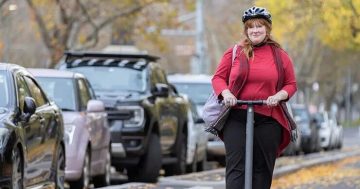
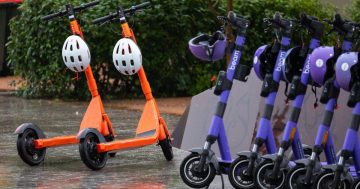
Government is encouraging active travel but are people being seriously injured because of it? Photo: ACT Government.
Region Canberra recently published the story: Enough of these shenanigans: Is Canberra’s love of Lime turning sour?
This reported that in April, 1800 e-scooters and e-bikes suddenly hit the roads. Four months later there are complaints about rider behaviour, dumped scooters and bikes obstructing paths, and concerns about intoxicated riders.
And in the story is a really important point. There is a lack of consistent data.
The national road toll has been rising.
In 2024, around 1300 Australians died on our roads – up from the low point reached during the pandemic (understandably).
Motorcycle deaths have risen particularly sharply. The number of injuries has also increased.
In that time our streets have changed. There are more e-scooters, more e-bikes, more motorcycles and a lot of people riding around delivering food for a living.
And we don’t really know how much these changes are contributing to road deaths and serious injuries – if at all.
E-scooters are fast enough to cause serious injury while offering the rider virtually no protection. They also challenge our transport system. Pedestrians, cyclists, motorists and e-scooter riders are increasingly sharing spaces that weren’t necessarily designed for all of them.
We are encouraging a new form of transport while struggling to answer a valid question – are people being seriously injured because of it?
And then there is the recent Fair Work Commission ruling which guarantees delivery workers roughly $31.30 an hour for “engaged time”- that is, the period from accepting a delivery until completing it. It also provides accident insurance and other protections.
The extra protections are welcome. And yes, some of the cost will eventually be passed on to consumers. If someone wants to pay $40 for a cold hamburger and chips, that’s their call.
But does the new higher pay encourage safer riding and driving – which is the claim – or does it still reward completing each delivery as quickly as possible?
If a person is paid for the delivery and not for the time spent waiting for the next one, is there an incentive to complete deliveries quickly? The faster one delivery is completed, the sooner another can begin.
And anyone who spends time on Australian streets will recognise some of the behaviour that results: riders moving quickly between roadways and bike paths, filtering between cars, taking shortcuts, and sometimes treating traffic lights as a suggestion.
We know people are being hurt. Safe Work Australia recorded 10 food-delivery workers killed at work between 2019 and 2021. NSW records from 2021 identified 183 injury claims and four fatalities involving food-delivery gig workers.
Menulog reported 85 injuries and four serious injuries nationally over roughly 17 months in 2020-21.
These are snapshots rather than a comprehensive national picture – which is a problem.
We have national data on road deaths. We have national data on workplace fatalities. But we don’t have reliable national data on how many gig workers are injured on the job.
The increase in gig-worker pay has been mainly justified on safety grounds. But if it is a safety reform, we should be able to measure whether it worked.
There is already research, for example, that has found fewer accidents when transport drivers are paid per hour and more when they are paid per delivery.
If a worker is financially rewarded for completing jobs faster, there can be pressure to work faster. If a worker is paid for their time, there will be less financial incentive to take risks to save a few minutes.
There is another group missing from much of this debate. The delivery rider is sharing the road and public spaces with pedestrians, cyclists, car drivers and their passengers, people walking their dogs, fitness addicts, old people, kids coming home from school, buses, trams and so on.
The delivery rider may be trying to earn a living, but are others not considered in this arrangement?
This isn’t an argument against e-scooters or gig work, or against giving poorly protected workers better insurance and minimum standards. It is an argument for taking road safety seriously.
We must collect data that allows us to see whether changes to gig-worker payment arrangements actually make roads safer because we have fundamentally changed who is using our roads and how they are being used. Perhaps those things are unrelated. Perhaps they aren’t.
If we are going to call something a safety reform, let’s make sure it actually makes people safer – the riders, drivers, pedestrians, cyclists, teenagers and children.
Original Article published by Peter Strong on Region Canberra.