
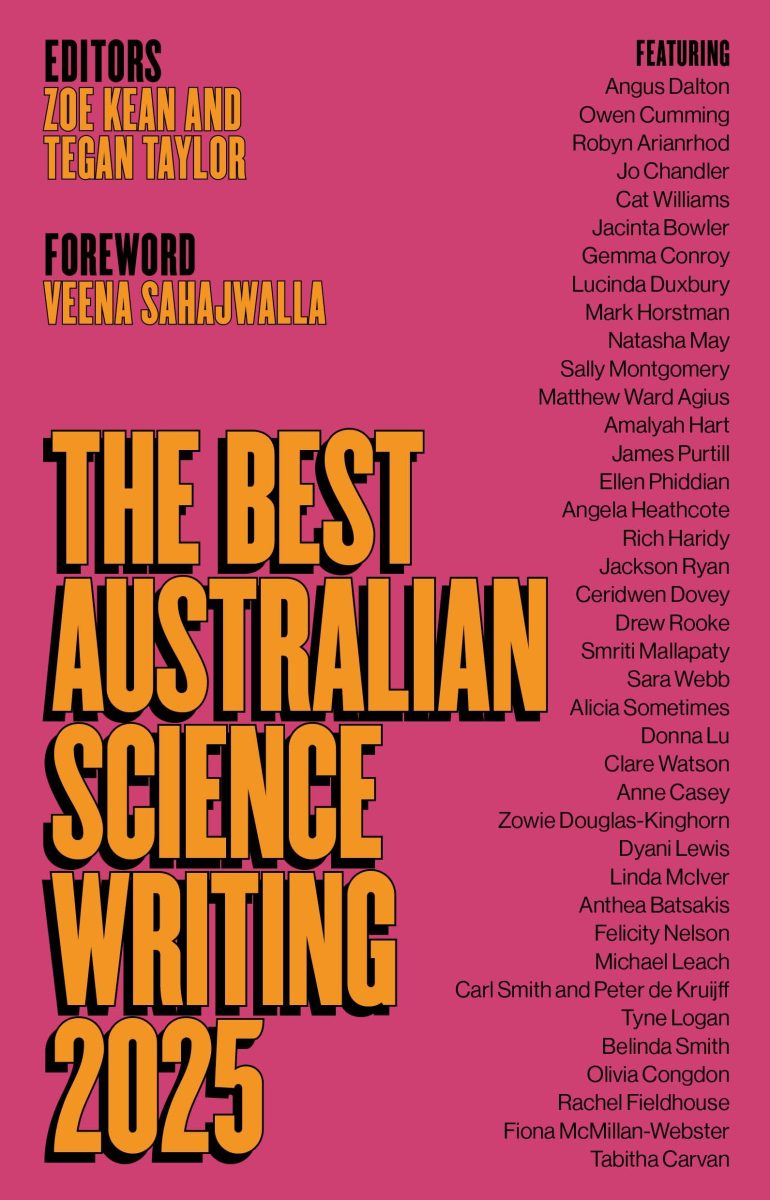
Award-winning science writers Zoe Kean and Tegan Taylor have compiled a fascinating anthology titled The Best Australian Science Writing 2025. Photo: Supplied.
The three winning essays of the 2025 UNSW Press Bragg Prize for Science Writing are featured in The Best Australian Science Writing 2025. The winning essay is by Tabitha Carvan, and the runners-up are Angus Dalton and James Purtill.
The most engaging, touching and engrossing stories from Australian writers, poets and scientists are showcased in this anthology, which is in its 15th year. The collection of short- and long-form prose, opinion and poetry promotes both established and emerging Australian voices, and covers themes that range from the impact of AI and the climate crisis to the complexities of the natural world and the potential of space exploration.
Some interesting questions come to mind. Why do we like robots that act like humans? What kind of inner life does an insect have? Can exoplanets offer us a better home?
Zoe Kean and Tegan Taylor offer some insight “into a constellation of bright minds”. Through the articles, we uncover the narrative within the data.
“The stories in this book do that, joining the dots to tell tales of the universe that scientists have worked hard to reveal,” the editors claim. “The pieces range from the sublime to the silly, the mournful to the majestic. They encompass hope, fear and the type of awe you feel looking through a telescope on a crisp night.”
Science is a deeply human endeavour and the stories we tell about it can be powerful, life-changing forces for good. The best science writing doesn’t just answer questions, it cracks them open. It dissects them, probes them and solves their mysteries. It takes you on a journey of discovery. It can show us the windblown work of Antarctic researchers as they drill into floating ice shelves, examine the possibility of language in whales, educate us on how to understand data and its limitations, and describe the fervour that accompanies the opening of a corpse flower.
In The Unexpected Poetry of PhD Acknowledgements, Tabitha Carvan wrote a unique piece. She expertly demonstrates her joyous and moving journey down the rabbit hole of PhD acknowledgements. Carvan’s piece captures both the loneliness of science and the fact it rarely happens without community.
Angus Dalton elaborates on the science behind the stinky floral structure in The Night I Accidentally Became a Corpse Flower’s Bedside Manservant. He uses luscious and lewd prose to describe the fervour that accompanies the opening of a corpse flower dubbed ‘’Putricia’’ at the Sydney Botanic Garden.
That was one of the stories where “joy and absurdity burst through some of this year’s stories”.
We know the threat of climate change is ever present. So, while a government report on air conditioning in Australia may not seem like the most inspiring source material, James Purtill’s Air Conditioning Quietly Changed Australian Life in Just a Few Decades contends with Australia’s energy situation.
Kean and Taylor, both award-winning science writers, claim Purtill’s tracing of our zero-to-100 addiction to cooling systems is “one of the more creative and clear pieces on climate we have read”.
In a political atmosphere where climate data and models are often confusing and controversial, Tyne Logan expertly and clearly lays out the challenges scientists face when modelling our changing climate.
In the foreword, Scientia Professor Veena Sahajwalla says scientific research is how we will solve our big human challenges, and the stories within this publication show researchers striving to address the biggest of them all in our lifetime.
“A sense of the urgency involved comes through in this anthology: from the young scientist looking out at Arctic ice sheets and considering that they may no longer form by the end of her career, to the detailed look at nuclear fusion research in China,” Professor Sahajwalla writes.
The materials scientist, engineer and inventor also touches on Australia’s waste and resource recovery industry being increasingly challenged by complex wastes and how dealing with refuse in sustainable ways requires us to challenge conventional wisdom and explore unconventional approaches.
“The challenges we face are significant, but by fostering inter-disciplinary collaboration, embracing future-focused technologies, and cultivating a diverse and inclusive scientific community, we can develop the innovative solutions needed to translate science into applications that help create a sustainable future for all.”
Professor Sahajwalla commends this anthology as we rethink our approach for a sustainable future. Scientific discovery and science writing itself can create greater connectivity between and across markets, sectors, communities and cultures, enabling pathways to achieve new national and global opportunities.
The Best Australian Science Writing 2025, edited by Zoe Kean and Tegan Taylor, NewSouth, $32.99