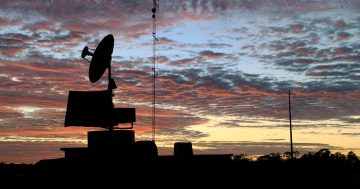
New croc detection technology is being trialled to improve public safety. Photo: Supplied.
The feasibility of a potential breakthrough in crocodile detection technology is being tested in North Queensland.
The Department of the Environment, Tourism, Science and Innovation (DETSI) is collaborating with James Cook University (JCU) to develop a device to detect crocodiles and it has now been given the green light to proceed with testing.
In theory, the device can spot crocodiles swimming in the water by linking state-of-the-art cameras and artificial intelligence (AI) technology trained to identify crocodiles.
The detection system is mounted on a mobile camera platform, configured as a trailer, for easy transportation to different locations as the trial phase rolls out.
The device is now going to be deployed to see if and how it can be used to help keep Queenslanders safe from crocodiles.
DETSI Senior Conservation Officer Daniel Guymer said JCU researchers analysed thousands of hours of footage supplied by DETSI to train the AI technology that can differentiate between crocodiles and other floating objects in the water.
“The aim is to create a reliable detection system that could be deployed on fixed or mobile infrastructure in high recreation-use areas,” Mr Guymer said.
“This is a significant step forward as we continue looking at innovative ways to improve public safety in areas where crocodiles also live.
“If successful, this technology could revolutionise how we monitor crocodiles, providing real-time data to help us manage crocodiles as effectively and efficiently as possible.”
There have been 51 recorded crocodile attacks on people in Queensland in the 40 years to December 2025, 16 of them fatal.
The most recent recorded crocodile attack occurred on 25 October 2025. This incident took place at Myall Beach near Cape Tribulation and was not fatal.
In August 2024, Dr Dave Hogbin was fatally attacked by a 4.9m saltwater crocodile in the Annan River, south of Cooktown, after falling down a bank. He had been holidaying with his family.
Project lead, Senior Lecturer and Co-Deputy Head of JCU’s newly established Centre for AI and Data Science Innovation, Dr Tao (Kevin) Huang said baseline tests had demonstrated the AI technology could detect crocodiles.
“This is a huge benefit for community safety, and we now need to check that it can detect crocodiles in the water in real time,” Mr Huang said.
“If the program is successful, it could lead to the technology being used at public locations such as boat ramps or in marinas.
“Our aim is to detect crocodiles, while also considering future extensions of the AI technology to estimate their size, which could assist wildlife rangers in investigating sightings.”
The partnership will assess the feasibility of the detection system, with researchers optimistic about its potential to deliver practical solutions for crocodile management.
The new Queensland Crocodile Management Plan prioritises public safety while also seeking to conserve crocodiles in their natural habitat.
Crocodile sightings can be reported by using the QWildlife app, completing a crocodile sighting report on the Department of Environment, Tourism, Science and Innovation website, or by calling 1300 130 372.
Original Article published on Cape York Weekly.