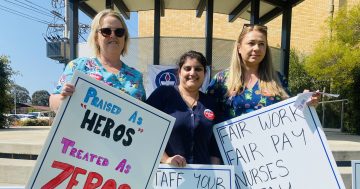
Members voted to reject the government’s latest offer despite the ANMF recommending it be accepted. Photo: ANMF (SA Branch).
Members of the South Australian branch of the Australian Nursing and Midwifery Federation (ANMF) have voted to reject the State Government’s latest enterprise bargaining agreement (EBA) offer.
The offer included a wage increases of 16 per cent over three years and a number of industrial improvements and protections that had been sought during negotiations.
The ANMF had previously recommended that its members accept the offer.
“Our recommendation is a strategic decision to secure significant gains now while continuing to build momentum for future bargaining rounds,” ANMF (SA Branch) CEO/Secretary Adjunct Associate Professor Elizabeth Dabars said on 25 June.
“Every improvement in this offer has been achieved because members stood together, and that collective strength will continue to drive future gains.”
But on 30 July ANMF members rejected the offer. The union said the vote reflected the collective decision of nurses and midwives, and demonstrated the strength of member engagement throughout the bargaining process.
“Our members have made their choice and we respect that decision,” Ms Dabars said.
“Nurses and midwives have carefully considered the offer and determined that it does not adequately address the issues they believe are important for their professions, their workplaces and the safe delivery of care across South Australia.”
The vote will see the EBA process enter a new phase, with the government advising it intends to pursue arbitration to determine the outcome.
The ANMF (SA Branch) is prepared for arbitration and will continue to advocate strongly on behalf of nurses and midwives.
“Our legal team has been actively preparing for this possibility, and significant work is already underway to ensure we present the strongest possible case,” Ms Dabars said.
“In the coming weeks, we will work closely with members across metropolitan, regional and remote South Australia to identify witnesses and gather evidence to support our case.
“The experiences of nurses and midwives on the frontline will be critical in demonstrating the realities of contemporary practice, workforce pressures, increasing complexity of care, professional responsibilities and the issues that remain unresolved.
“Our focus has not changed,” she added.
“We will continue to stand alongside our members and advocate for outcomes that recognise the vital role nurses and midwives play in delivering safe, high-quality care to the community.”
Negotiations over the EBA have been underway since late April 2025. In December, the ANMF submitted two proposals to the government, both of which they say went unanswered.
“The lack of a revised offer is disappointing, disrespectful and unacceptable,” Ms Dabars said on 23 January. “Silence will only worsen workforce shortages and place further strain on our health system.”