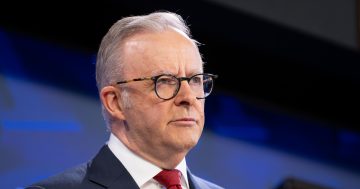
New Greens David Shoebridge is at the helm of a party that’s not all happy with itself. Photo: John Lomnicki.
What a difference a leadership change makes.
Since David Shoebridge took the helm of the 11-member parliamentary Greens a few days ago, the minor party has been spewing policy ideas as if it were in the middle of an election campaign.
Not content to simply critique government policy or attack the Opposition’s offerings, the Greens are quickly trying to position themselves as the thought leaders in Australian politics.
Shoebridge wants to end the nation’s alliance with the United States; nationalise Coles and Woollies; establish a statutory authority to set grocery prices; end One Nation; and replace Labor.
That all sounds mightily ambitious, if not outright overly wishful thinking (some might say ridiculous).
It’s a good thing for a new leader to bolt out of the gates champing at the bit, but there’s more going on here than an eagerness to promote policy debate.
The Greens are not a happy camp right now, and Shoebridge has to establish his authority internally before the house of cards comes tumbling down.
Since Larissa Waters’ shock resignation last week and Shoebridge’s ascension to the top job, there have been numerous reports – some strategically leaked to the media and others outright publicly made – of internal unrest.
Mehreen Faruqi, who lost out to Shoebridge in the leadership contest, immediately declared what some have interpreted as war.
She criticised the election process, called for rules to be changed to install a membership-wide vote, and chose not to recontest the deputy leadership role so she could better pursue “radical action outside the constraints of the leadership team”.
Shoebridge had to respond by publicly downplaying the tensions and declaring “every single member of the federal Greens party room is basically a frontbencher”.
The other leadership contender last Wednesday (30 September), Sarah Hanson-Young, isn’t too happy either.
She was kicked out in the first round after an altercation with Waters over the outgoing leader backing Shoebridge.
Hanson-Young reportedly gave Waters a blast for backing a bloke for leader, and declaring the “sisterhood doesn’t exist”.
Apparently the factions (yes, there are factions inside the Greens just as aggressive and ‘nasty’ as Labor’s) made it play out the way it did.
Publicly, Hanson-Young’s social media posts reveal how frustrated she is with how it all played out.
“God, politics can be brutal,” she said in a video on Thursday.
“Friendships made and lost, but it takes all types. We all care so deeply about the future of this country and the future of the planet.
“Australians deserve an optimistic, caring, and defiant progressive force, and I won’t be backing down.
“I’m sorry we couldn’t pull it off this time, but buckle up, because we’ve got a lot of work to do.”
Those are telling words, and together with Faruqi’s public gripe, they suggest a party that isn’t fully unified or happy with itself.
Little wonder then that Shoebridge is out there on the policy front, painting a picture of a party on the go.
The US “wants to fight their next war from Australia”, he said in one media interview, and that proves the alliance is a “deep betrayal of Australia’s interests”.
That was guaranteed to grab a few headlines.
“Australia is in one of the most geopolitically safe parts of the planet,” he said.
“We have the Pacific Ocean on one side, the Indian Ocean on the other, this massive island archipelago, and thousands of kilometres between us and any other significant landmass, and our only security threat comes from hosting a superpower’s bases here that make us a target in a conflict.
“The United States wants to fight its next war from Australia … I can understand why the United States might want to do this – it may well be in their interests.
“But for the life of me, I cannot understand how the Labor Party, the Coalition, and One Nation all want to do this.
“It is a deep betrayal of Australia’s interests. It is a deep, deep betrayal.”
Those comments will resonate with more than a handful of Australians.
As will giving the go-ahead for the party’s think tank, The Green Institute, to outline a $25 billion plan to nationalise major supermarkets; fund hundreds more stores (to be called Fair Go Grocers); and establish an overseeing price-setting office.
New York’s mayor Zohran Mamdani is implementing a plan for five grocery stores, one in each of New York City’s boroughs, to be owned and subsidised by the city.
The New Zealand Greens have a plan to nationalise 120 supermarkets and set up a new publicly owned chain.
Those overseas examples could inspire the Australian Greens to act under their new leader.
But he also needs to be seen as proactive on the policy front if he has any hope of taking the unsettled party with him on the next leg of its journey.
Original Article published by Chris Johnson on Region Canberra.