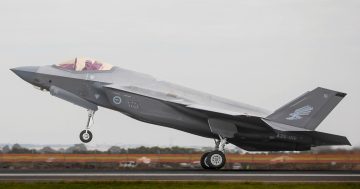
The F-35’s canopy transparency is made from two sheets of stretched acrylic polycarbonate with a layer of gold and other stealthy materials in between. Photo: WOFF Ricky Fuller, ADF.
A shipment of components from Royal Australian Air Force F-35 Lightning II combat aircraft reportedly went missing in June after being diverted to Hong Kong.
US media reported on 19 September that the parts were being returned to the aircraft’s manufacturer Lockheed Martin in the US for repair, and that the US Department of Defense has confirmed that some of them being transported by an intermediary disappeared after the shipment was diverted to the China-controlled Hong Kong.
Politico said the Pentagon’s F-35 Joint Program Office (JPO) confirmed it was “aware of a shipment issue of unserviceable F-35 Lightning II components”, and that it said it was working “to retrieve these components, investigate the incident, and place safeguards to avoid a future occurrence”.
On 23 September, The Nightly reported that the intermediary tasked with transporting the components is the French-owned logistics company, CEVA Logistics.
The shipment reportedly includes a cockpit canopy transparency.
As part of Australia’s acquisition of the F-35A of which it operates 72 aircraft, the capability to maintain and upgrade the aircraft in country was also established, primarily at the BAE Systems depot located at RAAF Base Williamtown.
But the canopy is a highly-specialised component which few companies have the capability to manufacture and maintain, so it is not uncommon for these to be returned to companies such as PPG or GKN Aerospace in the US or UK for repair and maintenance.
The F-35’s canopy features two sheets of stretched acrylic polycarbonate, between which an ultra-thin layer of gold and other material which gives them a yellowish tinge is used as a radar-absorbent barrier to prevent emissions from escaping, or adversary radar waves from penetrating the cockpit.
One of the key drivers of the multinational Joint Strike Fighter (JSF) program from which the F-35 was developed – and of which Australia is an international partner – was that the aircraft featured a range of new and highly sensitive technologies such as stealth shaping and materials, data fusion, and advanced sensors, much of which was not previously available for sale to any other countries.
As a result, partner nations and customer air forces have been required to dramatically bolster security at all bases from which the F-35 operates.
This includes building a separate compound within the base perimeter for F-35 hangars, a tightening of security requirements for Defence and civilian personnel to enter an F-35 base or project office, and a ‘hardening’ of communications systems and buildings on bases to prevent sensitive data from being accessed.
Defence Minister and Acting Prime Minister Richard Marles was asked about the missing components and what Australia was doing to assist the US in tracking them when he visited RAAF Edinburgh on Tuesday (22 September).
“We are obviously working with the United States and obviously with its prime contractor Lockheed Martin, in respect of this,” he said.
“We are examining very much everything that has occurred at the Australian end, but the point I would make here is that we are confident about the way in which we’ve engaged with the program, and through the US’s prime contractor, Lockheed.
“My understanding is that there is a sense of comfort, and we’re not talking about sensitive equipment here or sensitive parts,” he added.
“Ultimately, though, this is an issue which is going to be managed by the United States and by Lockheed in terms of what has occurred.”
When pressed on how sensitive some of the components are, he referred the question to the Pentagon or to Lockheed Martin.
Politico said Lockheed Martin was unable to discuss the shipment for security reasons, but the company did say it follows all of the US Government’s regulations for shipping such components.
“Our teams handle every shipment with the utmost diligence and safeguards to ensure the integrity of the F-35 program and the security of our allied partners,” it said in a statement.
China is reported to have successfully hacked data from the F-35 program during the aircraft’s development, and has used some of that information in the development of its own stealth fighters, the J-20 and J-35.
Former US House Armed Services Committee staff member and Congressional Research Service military aviation analyst, J.J. Gertler told Politico, “It’s no secret that China has been aggressively trying to get F-35 data through electronic espionage, among other means.
“But even if they already had specifications or other data about the part, possessing a real one can give them even more to go on and can verify or refine whatever they already had learned.”