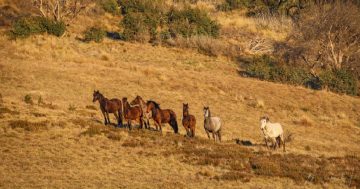
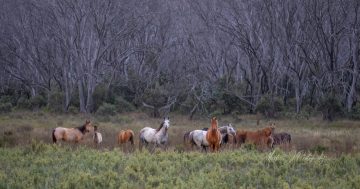
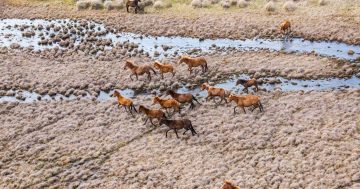
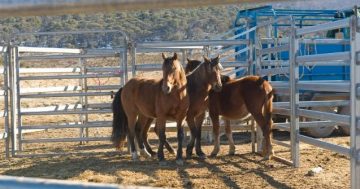
The NSW Land and Environment Court has rejected a second urgent bid this year to halt wild horse culling in Kosciuszko National Park. Photo: NSW Courts.
The NSW Land and Environment Court has rejected a second urgent attempt this year to halt wild horse culling operations in Kosciuszko National Park (KNP).
Brumby advocate Carmen Jackson filed for an injunction on Thursday (27 August), seeking to prevent aerial and ground shooting, trapping, removal and killing in trap yards while the court considered her broader legal challenge.
At the centre of her case is whether the department and those carrying out the operations have the authority required to trap, shoot or otherwise harm wild horses in the park.
Ms Jackson represented herself when the application came before Justice Sarah Pritchard the following Wednesday (2 September).
Justice Pritchard dismissed the injunction after finding Ms Jackson had not established a serious question over whether the staff involved were properly authorised.
Ms Jackson questioned whether each employee, contractor, shooter and trap operator involved had the authority required under the National Parks and Wildlife Act 1974.
The act generally prohibits people from harming animals in national parks unless they are authorised to do so or are carrying out a legal duty.
Ms Jackson did not claim the required authorisations did not exist, but said she had been unable to identify them.
Instead, she wanted the NSW Department of Climate Change, Energy, the Environment and Water (DCCEEW) to identify the authorisations being relied on, including who issued them, when they were made and which people, animals, locations and control methods they covered.
She argued the operations should be suspended until the case was decided because any harm caused in the meantime would be irreversible.
“Once an individual horse has been killed, that consequence cannot be reversed by a subsequent judgment of the court,” Ms Jackson said in an affidavit.
DCCEEW argued the operations were authorised under the Kosciuszko National Park Wild Horse Heritage Management Plan 2021 (WHHMP) and the National Parks and Wildlife Act 1974 (NPW Act), which requires the department’s secretary to put the plan into effect.
Under the WHHMP, approved control methods include passive trapping, mustering, removal for rehoming or transport to an abattoir or knackery, shooting in trap yards, ground shooting and aerial shooting.
DCCEEW principal legal officer Nicholas Sandstrom told the court all 10 National Parks and Wildlife Service (NPWS) employees involved in operations before the aerial shoot scheduled to begin on 2 November had authorisations under section 171 of the NPW Act.
Six were covered by a general authorisation issued in December 2019, while four held individual authorisations.
Justice Pritchard accepted the evidence that the staff were legally permitted to harm animals in a national park.
The court then considered whether the consequences of stopping the operations outweighed the harm that would result from allowing them to continue.
Ms Jackson argued there was a, “fundamental asymmetry” between temporarily postponing operations and killing horses, which could not be reversed.
DCCEEW argued a delay would disrupt planned operations, increase costs and allow environmental damage caused by wild horses to continue.
The court heard postponing the November aerial operation could require NPWS to redeploy 14 staff, including four trained shooters.
If its helicopters were unavailable when the operation was rescheduled, replacements would cost around $12,925 a day to hire, they said.
Under the WHHMP, the wild horse population must be reduced to 3000 in designated retention areas by 30 June 2027 and maintained at zero elsewhere in the park.
The court heard the population in surveyed areas was estimated at 10,309 in October 2025.
DCCEEW said wild horses damaged native habitat through grazing, trampling and erosion, and degraded streams and wetlands.
The WHHMP also records damage to Aboriginal artefacts and cultural landscapes.
Justice Pritchard accepted that killing horses caused irreversible harm and acknowledged the strong feelings held by Ms Jackson and other members of the community.
However, she found stopping the operations would have consequences beyond financial and administrative disruption, including allowing environmental damage to continue and making it harder to meet the required population target.
She found the, “balance of convenience” favoured allowing the operations to continue.
The decision is the latest in a series of legal challenges to wild horse control operations in NSW.
In July, Matthew Holland and Roxanne Phoenix unsuccessfully sought an injunction against aerial and ground shooting in KNP after dead horses, including pregnant mares and what appeared to be an aborted foal, were found near Kiandra.
They argued the operations were cruel and breached animal welfare laws and the park’s management plan.
Justice John Robson found the evidence was insufficient to raise a serious question to be tried.
Their broader case is listed for a final hearing on 22 and 23 October.
Ms Jackson has also challenged shooting and trapping operations in Yuraygir National Park on the NSW North Coast.
Justice Rachel Pepper refused her application for an urgent injunction on 25 August, finding there was insufficient evidence to raise a serious question over whether the cull was lawfully authorised.
DCCEEW nevertheless agreed to suspend operations until the case’s final hearing on 9 and 10 September.
Meanwhile, ground shooting continued in KNP until Friday (4 September), while passive trapping and removal were also underway when approved rehomers were available.
No aerial shooting is scheduled until 2 November.
Ms Jackson’s broader Kosciuszko challenge remains before the court and will be heard on 1 October.
Original Article published by Edwina Mason on About Regional.