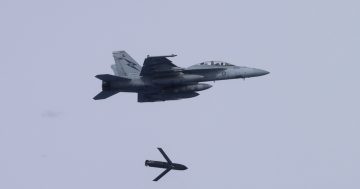
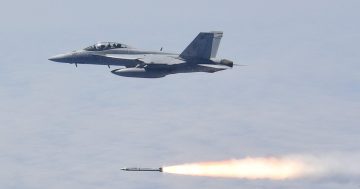
An AIM-260 test article on the Station 5 pylon of a US Navy Super Hornet at the Eglin AFB test facility in Florida. Photo: Jonathan Tweedy, @flightline_visuals.
Defence Minister and acting Prime Minister Richard Marles has confirmed the Royal Australian Air Force will become the first non-US operator of a still-secret new air-to-air missile.
Speaking at Darwin yesterday morning (6 August), the minister confirmed recent reports that the RAAF would equip its F/A-18F Super Hornets with the new Lockheed martin AIM-260A Joint Advanced Tactical Missile (JATM).
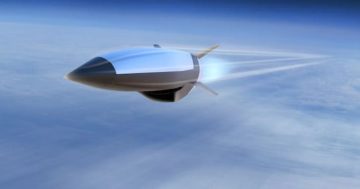
Under secret development since 2017, no official photos of the AIM-260A have been released by the Pentagon, although a low resolution rendering has appeared in a US Navy slide deck.
It wasn’t until May when Florida-based photographer Jonathan Tweedy took a photograph of a US Navy F/A-18F taking off from the US Air Force’s Eglin AFB test facility with what is likely an AIM-260 test article on one of its fuselage pylons that a more detailed image has been seen in public.
The RAAF’s AIM-260 acquisition is the first acknowledged order for the missile outside of the US military. Valued at A$736 million, the order will see the JATM replace older models of the Raytheon AIM-120C AMRAAM in service aboard the RAAF’s Super Hornets, and later on its F-35A Lightning IIs, and EA-18G Growlers.
The JATM program was launched in 2017 amid reports China was developing its own advanced beyond-visual range (BVR) air-to-air missiles reportedly capable of engaging targets out to 300 km range, double that of the latest version of the AMRAAM.
But being a secret/special access program, official information on the AIM-260A has been scarce. Reports indicate it has similar dimensions to those of the AMRAAM so as to maintain commonality with existing ground handling equipment and aircraft launch systems, but that it has a new advanced rocket motor which will give it an air-launched range of between 200 and 300 km.
Flight testing of the JATM reportedly commenced in 2021, but several development and aircraft integration issues have reportedly seen planned production of the missile delayed by at least two years.
The new missile will provide the RAAF with more than 120 km of additional reach over the model AMRAAM which will offer a greater opportunity for a first look-first shot at any crewed or uncrewed airborne threats, including cruise missiles.
The possible sale of the AIM-260s to Australia was first reported last December by reputable US publication Naval News, although nothing official appeared in US Department of Defense or State Department public documents until 30 March.
That March notification said Australia had been approved to buy up to 450 AIM-260s, as well as five AIM-260 Integration Test Vehicles (ITV), and 30 AIM-260 Guided Test Vehicles (GTV) for an estimated US$3.16bn (A$4.5bn).
Also included in the sale notification were communications security devices, spare parts, consumables and accessories, training equipment aids, weapon system support and test equipment, technical publications, and US Government and contractor engineering and support services.
The reduced amount of the sale announced by Mr Marles likely reflects a lower number of missiles in what will likely be the first of several acquisition tranches.
Mr Marles said it was fitting to make the announcement in Darwin at the multinational 2026 Pitch Black air combat exercise which is scheduled to end this weekend.
“This announcement is the latest milestone in the delivery of long-range, high‑tech capabilities for our Defence Force,” he said.
Minister for Defence Industry Pat Conroy added, “JATM missiles are some of the most sophisticated air-to-air weapons in the world, and Australia will be the first country to operate them outside the US.
“This investment will deliver the most advanced capability for our ADF to detect and counter threats.”