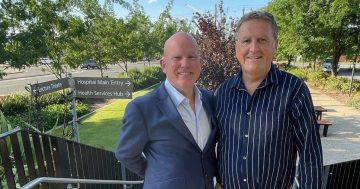
Professor Dominic Rowe, Helen Dalton MP and Health Minister Ryan Park celebrate the new MND register launch. Photo: Supplied.
The mystery behind why the Riverina has seven times the rate of deadly motor neurone disease (MND) compared to the national average is one step closer towards being solved, with a world-first system for tracking the devastating illness finally launched.
From Tuesday (1 September), doctors across NSW are required to notify NSW Health when a patient is diagnosed with MND, creating the first comprehensive picture of who is developing the disease, where they live and what they may have been exposed to.
For communities such as Griffith, Wagga Wagga and Leeton, where MND rates have previously been much higher than in metropolitan areas, the move could provide researchers with the data they have long argued is essential to finding out why.
Murray MP Helen Dalton has spent seven years campaigning for MND to become a notifiable condition, alongside leading MND specialist Professor Dominic Rowe AM.
She said the change was an historic moment for families across the Riverina who had spent years asking the same question: why are so many people here developing the disease?
“We cannot begin to find the cause if we do not have the data,” Ms Dalton said.
“For the first time, we can start building a clear picture of who is living with this cruel disease and where they are.”
Under the new system, NSW Health will collect information including a patient’s age, address, occupation, date of onset and other demographic and clinical details.
The data could allow researchers to identify patterns between MND cases and particular locations, occupations or environmental exposures.
That is particularly significant in the Riverina, where the unusually high rates have been known about for years but the research needed to explain them has struggled for funding.
A 2015 Macquarie University study found MND rates in Wagga Wagga, Griffith and Leeton were around seven times higher than in cities.
A research team led by French neuroscientist Professor Gilles Guillemin subsequently investigated possible causes in the Riverina, but the project was abandoned in 2020 after government funding was withdrawn.
The lack of research has been a source of enormous frustration for local families affected by MND.
Griffith MND sufferer Tania Magoci, who has described herself as a third-generation sufferer of the disease, spent years campaigning for answers and previously said: “If we could find what’s causing the high rates of this illness, we could develop ways of preventing it or helping those suffering.”

Tania Magoci has also fought for MND funding for several years. Photo: Oliver Jacques.
There has also been speculation about environmental factors.
Overseas research has investigated possible links between MND and long-term exposure to substances including pesticides and blue-green algae. Griffith’s Lake Wyangan, which has experienced recurring algal blooms, has previously attracted attention as one possible area for investigation, although no causal link between the lake and MND has been established.
Around 90 per cent of MND cases occur sporadically, with no apparent family link or known cause.
Professor Rowe said identifying who had MND was the first step towards understanding what caused the sporadic form of the disease.
“NSW is the first jurisdiction in the world to make MND a notifiable disease,” he said.
“The register will enable careful research into the environmental causes of MND, without which we will never understand the mechanisms involved.”
MND is a progressive neurological disease that destroys the nerve cells controlling voluntary muscle movement.
It progressively affects a person’s ability to walk, talk, swallow and breathe, and there is currently no cure.
Professor Rowe said people living with MND wanted to be counted and studied so researchers could finally understand the cause of the disease and develop treatments capable of slowing or stopping its progression.
Ms Dalton said the immediate challenge was making sure the new system captured not only newly diagnosed patients but the estimated 750 people already living with MND across NSW.
She also called for Professor Rowe and other MND specialists to remain closely involved as NSW Health implemented the system and determined how the data could best be used for research.
“This is a major global win but it is not the finish line,” Ms Dalton said.
“We need to make sure every person living with MND is captured so researchers have the information they need to investigate possible causes, improve treatments and, ultimately, help find a cure.”
Original Article published by Oliver Jacques on Region Riverina.