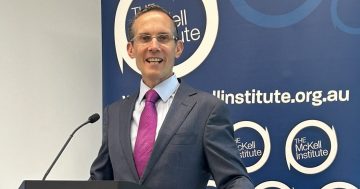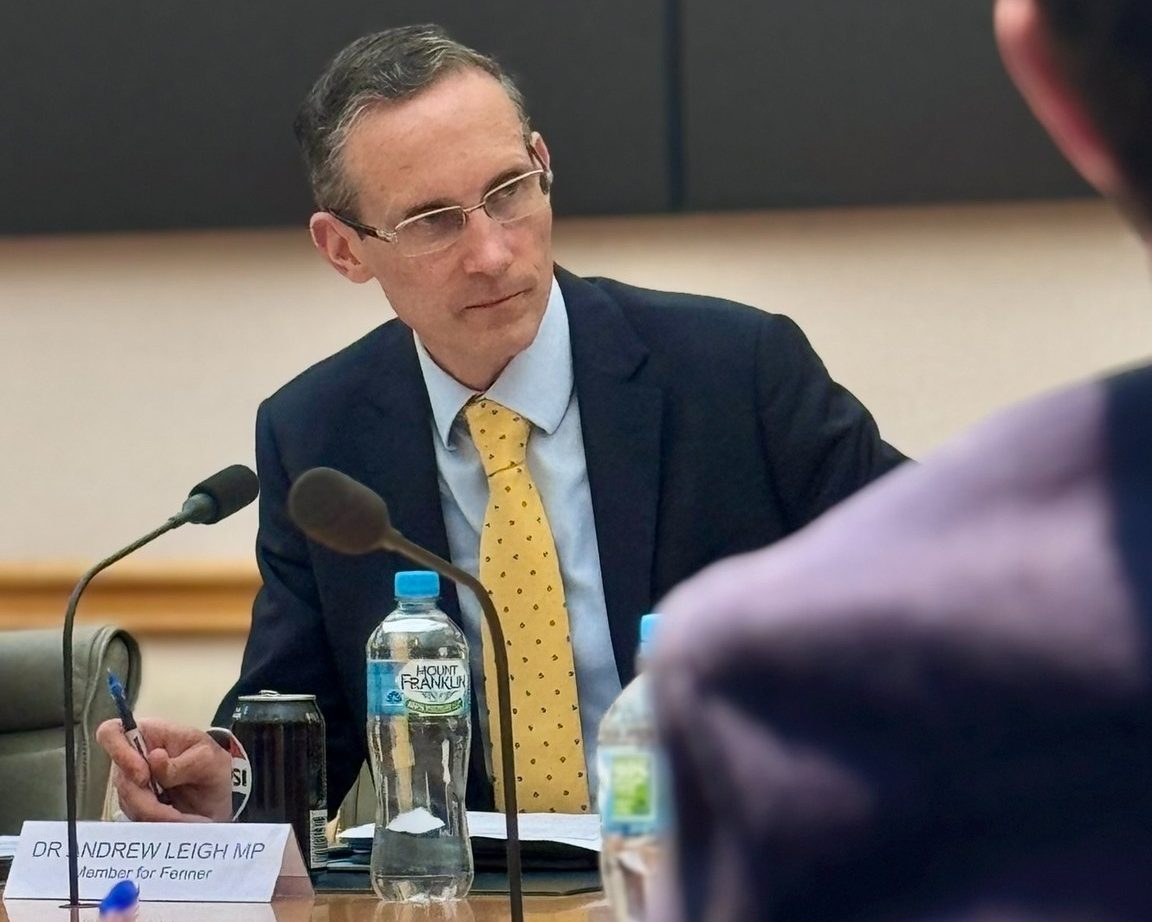
Assistant Minister Andrew Leigh will outline the results of several of the government’s randomised trials. Photo: File
Randomised trials across the public sector are delivering useful results, the Federal Government says, making policy evaluation much easier.
One Australian Government trial has found that sending a text before a Services Australia call actually increases successful contact rates, raising them from 52 to 64 per cent.
Another is Treasury’s work with the banking sector, testing ways to encourage customers to seek a better deal on their home loan or savings account.
In one such trial, a message that customers could easily overlook had little effect.
But a second trial showed the value of giving the message greater prominence and tailoring it to the recipient.
When customers were told prominently that they might qualify for a lower rate on their particular loan, the share contacting the bank rose from 4.8 per cent to 7.2 per cent, an increase of 50 per cent.
Assistant Minister for Productivity, Competition, Charities and Treasury Andrew Leigh says this helps someone decide whether a call to the bank is worth the trouble.
Information about their own mortgage gives them a reason to do something – and the experiment helped establish which approach could prompt that conversation.
“We’re also evaluating Australia’s social media minimum age laws, and the electric car discount,” Dr Leigh said.
“There is growing use of rigorous evaluation across the Australian Public Service – how governments can use experiments to find out which policies actually work, rather than relying on intuition or good intentions.”
The Assistant Minister will outline results and ongoing development of a number of the government’s randomised trials during his closing address at the Australian Centre for Evaluation (ACE) and the Behavioural Economics Team of the Australian Government (BETA) showcase event at the National Convention Centre.
ACE and BETA help agencies ask useful questions and choose methods that can answer them.
They also help public servants acquire the skills to do this work themselves. The goal is for evaluation to become part of program design, so the initial rollout also allows the public service to test impact.
The opening example the Assistant Minister will give is one of a randomised trial further afield and goes right to the heart – and pitfalls – of the growing embrace of artificial intelligence.
“Imagine finishing a day’s work convinced that your new AI assistant has saved you an hour; then discovering that it has actually kept you at your desk longer,” he will say.
“That is roughly what happened to a group of experienced software developers in a randomised trial published last year.
“The research organisation METR recruited 16 developers to work on software projects they knew well.
“They brought 246 real tasks to the experiment. For each task, random assignment determined whether they could use AI assistance or would work with conventional tools.
“Before they began, the developers expected AI to cut the time required by about a quarter. The result went the other way. With access to AI, they took 19 per cent longer.
“And here’s the best bit of the study: even after doing the work, developers still believed AI had saved them 20 per cent of their time.”
Dr Leigh says the key to trials is to remember that, often, when doing evaluations, the approach is to ask people how the intervention affected them.
Prioritising local voices, recognising that those affected by a new tool, program or policy know best is vital.
“Except in this case they didn’t,” he says.
“If we’d assessed AI based on surveying the developers, we would’ve come away with a funky story about boosting productivity.”
The recent review of the government’s electric car discount, led by ACE, combined stakeholder consultation with a “difference-in-differences analysis”.
It compared changes in sales of battery electric vehicles priced below the discount’s eligibility threshold with changes in sales of vehicles priced above it.
That comparison helped answer a question at the centre of any subsidy review: how much of the activity would have happened anyway?
The review estimated that the discount generated about 64,000 additional battery electric vehicle sales during its first three years.
“That is a much more credible measure of its effect than simply counting every eligible car sold,” Dr Leigh says.
The Impact Evaluation Practitioners Network, established by ACE and the Australian Education Research Organisation, has grown to more than 700 members over two years, bringing together specialists from government and academia.
ACE also chairs the Australian Public Sector Evaluation Network in collaboration with the Australian Evaluation Society.
“It’s a place for public servants to meet academics and consultants who share an interest in rigorous evaluation of government programs,” Dr Leigh says.
“A well-designed evaluation can tell us where an approach is succeeding and where we should change tack.
“That matters for productivity. Public money goes further when we understand which programs deliver worthwhile results.
“Evaluation can help improve the way a service operates … or inform a larger decision about where resources should go.”
Original Article published by Chris Johnson on Region Canberra.