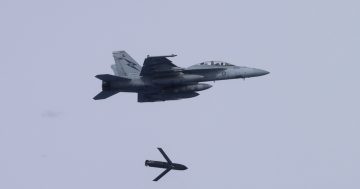
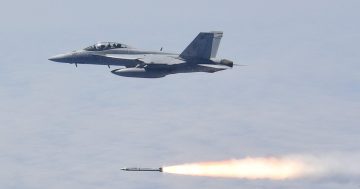
An AGM-158B JASSM-ER is launched from an RAAF F/A-18F Super Hornet. Photo: Screenshot.
Two new long-range precision strike weapons have achieved an initial operational capability (IOC) with the Royal Australian Air Force (RAAF).
The air-launched AGM-158B Joint Air-to-Surface Standoff Missile — Extended Range (JASSM-ER) and AGM-158C Long-Range Anti-Ship Missile (LRASM) are from the same family of weapons developed by Lockheed Martin.
Both have been developed from the earlier AGM-158A JASSM, which entered service with the RAAF in 2010 as a standoff weapon for use on the F/A-18A ‘’classic’’ Hornet. With the classic Hornet’s retirement in 2021, it’s unclear whether the RAAF’s JASSM war stocks have been retained for use aboard the RAAF’s F/A-18F Super Hornets, or are in storage.
The JASSM-ER shares a common airframe with the 370-kilometre-range JASSM, but has a more efficient jet engine and carries about 200 kilograms more fuel, giving it a range of more than 900 km.
After being given coordinates by the launch aircraft, it uses an inbuilt GPS Inertial Navigation System (INS) as well as an infrared seeker to guide it to within three metres of its target. The 500 kg penetrating warhead allows it to bust through reinforced concrete used in command and control centres, aircraft shelters, and other key infrastructure.
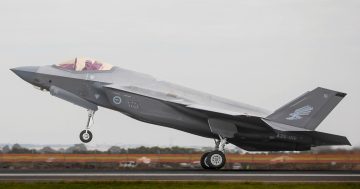
Then-Prime Minister Scott Morrison announced in September 2021 that the RAAF would acquire the JASSM-ER to equip the Super Hornet and later the F-35A Lightning II.
Successful operational test firings from RAAF Super Hornets were conducted in the US in February 2025 and at the Woomera Test Range in South Australia last November.
The February 2025, test firings of JASSM-ER in the US also saw the RAAF Super Hornets conduct test firings of the LRASM, the dedicated anti-ship variant of the AGM-158 family. Two LRASMs were fired over the Point Mugu sea range off the coast of California and successfully struck a towed moving barge stacked with containers to represent a ship target.


The operational test confirmed the RAAF is ready to induct the LRASM into operational service, and validated previous launch data obtained by the US Navy in testing with its own Super Hornets.
Being acquired under Defence’s Project AIR 3023 Phase 1 Enhanced Maritime Strike requirement, the LRASM will replace the ageing AGM-84 Harpoon anti-ship missile on the F/A-18Fs and larger P-8A Poseidon Maritime Response Aircraft, and will also be integrated with the F-35A.
Like the other AGM-158 family of missiles, the externally carried 400 km-range LRASM features a stealthy composite airframe, a small jet engine, and foldout wings. Using GPS/INS, it flies a pre-determined course to a target area where it can discriminate between friendly, civilian and enemy ships via a camera sensor and an onboard ship profile database.
At the recent Exercise Rim of the Pacific 26 (RIMPAC) naval exercise in Hawaii, an RAAF P-8A successfully launched an LRASM against a target, clearing the missile for service on that aircraft.
Chief of Air Force Air Marshal Stephen Chappell said the RAAF had demonstrated it was ready to conduct long-range, survivable and lethal maritime and land strikes against highly defended targets.
“By acquiring a suite of long-range maritime and land-strike missiles, Air Force will increase the lethality of our air combat aircraft and avoid increasingly sophisticated air defences,” he said.
“We are continuing to develop and grow Air Force’s ability to precisely strike targets at long range.
“This will allow Air Force, as part of the integrated, focused force, to further enhance deterrence by holding potential adversary forces and infrastructure at risk from a greater distance.”