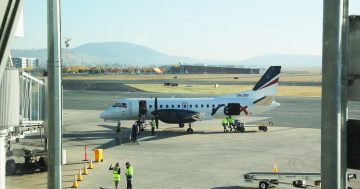
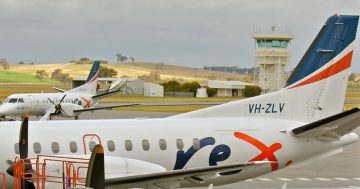
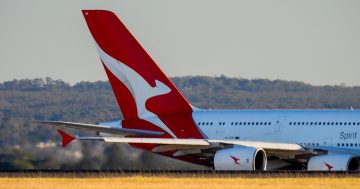
Qantas said the strike hadn’t affected passenger services at any of the country’s major airports. Photo: Andrew McLaughlin.
Several hundred Qantas freight handling and QantasLink ground services workers at major airports have staged a 24-hour strike today (28 October) over a pay dispute and work conditions.
The strike at Sydney, Melbourne, Adelaide, Brisbane and Perth airports are as a result of what the Transport Workers Union (TWU) says is the airline’s continued tactics to drive down pay and conditions. The airline’s Canberra workforce is not subject to the action.
The workers are tasked with handling freight including for Australia Post, and with QantasLink operations at Sydney Airport.
Under former Qantas Group CEO Alan Joyce, the airline’s ground and freight handling workforce was split across three entities: Qantas Airways Limited (QAL), Qantas Ground Services (QGS), and Australian Air Express (AAE).
The union says it is calling for fair pay in line with industry standards, more full-time jobs and hours, and for the workforce to be brought back under one Qantas banner to reduce what the union claims are deadly safety failings.
It says Qantas’ scattering of its workforce among multiple subsidiaries has splintered the aviation workforce, draining experience from airports and leading to dangerously unsafe standards for workers and the travelling public. A Qantas Freight worker was killed in September 2025, and a SafeWork investigation is ongoing.
TWU National Secretary Michael Kaine said Mr Joyce had gutted the airline, and that workers and travellers were still paying the price.
“They are forced once again to strike … because the alternative is an industry of dangerously unsafe standards for them and passengers,” he said.
“Under Joyce, Qantas mastered the art of creating new companies just to pay people less and take away full-time roles – not to mention the largest illegal sackings in our nation’s history.”
About 1800 Qantas baggage handlers, cleaners, and ground staff jobs were outsourced during the pandemic in 2020. In 2025 the move was deemed illegal by the Federal Court, and the airline was forced to pay a $90 million fine, and $120 million in compensation.
“Qantas’ disdain for its workforce has turned careers that people were proud of into scraps of increasingly unsafe work, with a revolving-door workforce and experience in freefall,” Mr Kaine added.
“Workers have been pitted against each other across different artificial companies so the airline can funnel more profits to executive bonuses.
“It is the people of this airline that make it the Spirit of Australia, and they are standing up today to rebuild the careers that Qantas used to foster.”
Qantas said there had been no disruption to the airline’s services as of 9 am Wednesday, and there had been no additional queues or delays.
“We are aware of planned industrial action by some of our freight and regional workgroups in Sydney and we have contingency plans in place. Importantly there will be no disruption to our customers,” an airline spokesperson told Region.
“We remain committed to reaching agreements with our employees that deliver substantial pay increases and reflect the priorities they have told us are important to them.”
The airline said there had also been no disruptions after a similar stop work action in September, and that freight operations at the new Western Sydney International Airport had not been impacted.
It said of the 32,000 employees in the Qantas Group, about 600 employees who are TWO members were eligible to take industrial action.
The airline says it has met with the TWU and has engaged constructively throughout bargaining for a new QGS agreement, including in the Fair Work Commission where it presented a proposal in an attempt to find a path forward.
It says it hopes to provide certainty for the workers and deliver a new agreement as soon as possible, and has put a proposed agreement directly to QGS employees that reflects the priorities they have articulated.
As a result, it says QGS employees will soon have the opportunity to vote on the proposed agreement which includes back pay from September 2025, a pay increase up to 26 per cent over the life of the agreement, and more full-time opportunities and more guaranteed part-time hours.