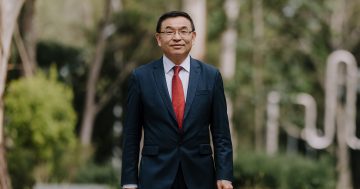
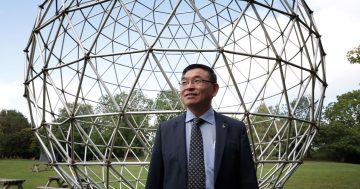
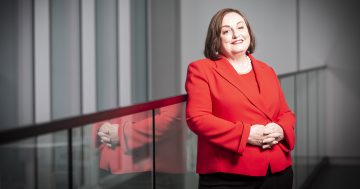
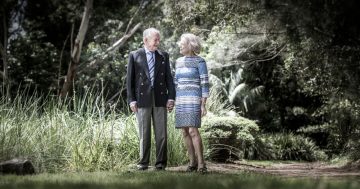
Former University of Wollongong interim vice-chancellor John Dewar (left) and chancellor Michael Still are under the spotlight at the ICAC inquiry. Photos: UOW/ICAC.
As the University of Wollongong was preparing an organisation-wide change which would ultimately make hundreds of professional staff redundant, its chancellor was prepared to hand one executive a new, more senior position and pay rise.
The ongoing Independent Commission Against Corruption (ICAC) inquiry into the university heard yesterday (Tuesday 30 June) from UOW’s chief people and cultural officer Alison Bourke, who said she was “shocked” when she first heard about the proposal at a meeting with the executive, former chief governance officer Alyssa White.
The inquiry, which is in its second week, is investigating allegations concerning senior UOW staff, including Ms White, chancellor Michael Still and former interim vice-chancellor John Dewar. Ms White resigned two days before the inquiry started and Mr Still stood down from his role in early June.
The inquiry will investigate whether Ms White or any other UOW staff partially exercised their official functions by intentionally subverting recruitment processes for governance roles, to benefit persons associated with Ms White.
On the opening day of the inquiry last week, Commissioner Paul Lakatso was told Ms White had allegedly created new job positions and, on at least 10 occasions, filled them with friends and former colleagues.
Counsel assisting the inquiry Emma Bathurst alleged Ms White had participated in and influenced the selection of the recruits, including shortlisting some of them for positions for which they lacked experience, or for which other candidates appeared to have more relevant or extensive experience.
A number of those recruits have given evidence since the inquiry opened on 22 June.
Ms Bourke had only been in the role of chief people and cultural officer for a matter of weeks when she had her first conversation with Alyssa White, she told the inquiry.
She said she was shocked by the “brazen” attitude of Ms White in pursuing a newly created role as vice-president strategy and executive affairs.
Ms White had allegedly told Ms Bourke in late January 2025 that the new position and remuneration of more than $388,000 had been approved by incoming vice-chancellor Max Lu. However, Professor Lu wasn’t due to start in the role until May.
A second recommendation – also allegedly approved by Mr Still and Professor Lu – was to retitle Stacy Oon’s role of associate director governance to director governance, with a remuneration of more than $235,000. The inquiry was told last week that Dr Oon was one of Ms White’s former colleagues at the University of Sydney.
Immediately after that meeting, Ms Bourke started making file notes of any conversation she had with Ms White and later with other senior executives about the proposed new position.
“The reason for that is towards the conclusion of that conversation, even though I expressed concerns immediately to Ms White, she had said everything was being folded into the change plan as part of the broader UOW transformation,” Ms Bourke said.
“From the 28th of January, I started an actual Word document to document very clearly what was happening and who I was speaking with.”
According to Ms Bourke’s notes, Ms White said she’d been in discussion with chancellor Still and Professor Lu on the design of a future vice-chancellor’s office and that a decision had been made to create a new vice-president role overseeing the office.
Ms White allegedly said Mr Still and Professor Lu had decided “that will be me”.
“I was shocked for various reasons that she was discussing the creation of a new senior executive role that she was putting forward, that she was the incumbent for,” Ms Bourke told the inquiry.
“Just how brazen it was – that it’s happening and that ‘it will be me’.
“I knew the importance of restoring trust and transparency across the workforce and that I would have thought, like the vice-chancellor appointment, that it would be a transparent, competitive selection process.”
Ms Bourke spoke with Mr Still the following day to outline her concerns and the potential risks of such an appointment.
She told Mr Still she was concerned about the legal risk of Professor Lu being named as the sponsor for the position when he wasn’t yet employed by the university.
Mr Still responded by saying “that’s fine, he has his contract”, according to Ms Bourke’s notes, and that “Professor Lu wants this in, that’s what he said to me”.
Ms Bourke told Mr Still that the university would “need to consider the need to advertise”.
According to her notes, Mr Still replied: “Definitely not.”
Ms Bourke suggested to Mr Still that the process be delayed until she sought legal advice with the university’s general counsel Rebecca Lim. However, she said Mr Still was “reluctant to delay further”.
“Would you agree with me, Ms Burke, that this conversation put you in a somewhat invidious position?” Ms Bathurst asked.
“That’s a very accurate description. Yes,” Ms Bourke replied.
Ms Bathurst: “You were strongly against what was being proposed by the paper [seeking approval of the roles by the Performance and Remuneration Committee] but the Chancellor was telling you that the proposal should go ahead.”
Ms Bourke: “Yes, he was.”
Ms Bathurst: “You wanted to do the job you were hired to do according to the processes but ultimately that wasn’t your decision, because you’re talking to the chancellor here.”
Ms Bourke: “Yes. Yes.”
Ms Bourke and Ms Lim flagged their concerns in a phone call with interim vice-chancellor Professor Dewar on 3 February.
He allegedly told the pair he considered the creation of the new position was “a very, very bad idea”.
Ms Bathurst: “So fair to say he agreed with you that there were significant risks … associated with proposing in – going forward in this way?”
Ms Bourke: “Correct, yes.”
Ms Bourke is due to continue giving evidence today (Wednesday).
The inquiry also heard yesterday from Aspirall Consultancy’s CEO Tanya Diesel. ICAC is investigating the circumstances around the selection and payment of the organisation and the role of Mr Still, Ms White and other employees in approving that work.
Although Ms Diesel had known Mr Still since 2008, she denied they were friends, rather “long-time business associates over 20 years. We do not have a friendship”.
The third item to be investigated by the inquiry is whether Mr Still or any other staff or contractor partially exercised their functions by failing to manage any conflict of interest relating to the employment of Professor Dewar as interim vice-chancellor and the university’s concurrent engagement of consultant KordaMentha.
The inquiry is due to run for three weeks.
Original Article published by Jen White on Region Illawarra.