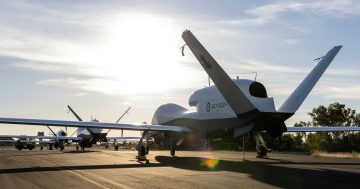
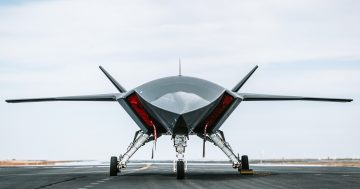
An edited image showing an MQ-4C Triton with notional NATO markings. Image: NATO.
Four NATO partner nations have signed a letter of intent (LOI) to buy up to five Northrop Grumman MQ-4C Triton high-altitude long-endurance uncrewed maritime reconnaissance aircraft.
The announcement was made at the NATO Summit Defence Industry Forum in Türkiye in early July. If it goes ahead, NATO will join the US Navy and Royal Australian Air Force (RAAF) as a Triton operator.
The announcement will likely be welcomed in Australia, which was a cooperative development partner for the Triton, especially as the US Navy has more than halved the number of Tritons it intends to buy leading to sustainment and development costs being shared across a much smaller global fleet.
The addition of an additional five aircraft and associated ground control systems in the European theatre will also increase the opportunities to establish joint user groups to share operational experiences and knowledge.
The RAAF now has three Tritons in service with No 9 Squadron, with a fourth due to be delivered in 2027. The aircraft and their maintenance personnel are based primarily at RAAF Tindal in the Northern Territory, while the system operators are based at RAAF Edinburgh near Adelaide.
The US Navy has reduced its Triton orders from an originally planned 68 aircraft to fewer than 30 in recent years, with its aircraft operating out of bases such as Anderson AFB on Guam, Kadena AFB in Japan, Sigonella in Italy, NAS Point Mugu/Ventura County in California, and NAS Patuxent River in Florida.
The MQ-4C is capable of operating missions of greater than 28 hours in duration, and at altitudes above 50,000 feet. It carries an AN/ZPY-3 MFAS maritime search radar, an electro-optical/infrared sensor, and advanced electronic and communications intelligence sensors, allowing it to cover more than four million square nautical miles in a single mission.
Data from the sensors can be transmitted via satellite to decision-makers or shared with allied aircraft or ships in real-time.
Apart from its maritime sensors, the Triton differs from the US Air Force’s RQ-4B Global Hawk and NATO’s RQ-4D Phoenix Alliance Ground Surveillance (AGS) on which it is based. It features a reinforced airframe, lightning protection, and de-icing systems on the engine intake and wing, all of which allow the Triton to descend to lower altitudes if required to identify small or non-metallic targets that don’t show up on radar.
If it goes ahead, the NATO aircraft would be operated jointly by Denmark, Finland, Germany and Norway in the Baltic Sea, North Atlantic, and the Arctic. Norway and Denmark already operate the crewed Boeing P-8A Poseidon maritime response aircraft which the Triton was designed to work with in the maritime environment, while Denmark has also ordered the P-8A.
In a statement, NATO said a transatlantic industrial consortium was being formed to deliver the Triton capability.
“The new aircraft will complement NATO’s Alliance Ground Surveillance (AGS) Fleet that operates from Sigonella airbase in Italy,” it said.
“While Northrop Grumman will build the Triton aircraft, Airbus Defence and Space and other European companies will provide the ground segment, data management services, command and control, infrastructure and mission support.
“This leverages the work and transatlantic relationships built upon the last decade to enable a modern and capable NATO ISR Force.”