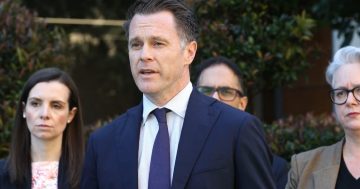
Assistant Customs Minister Julian Hill says current tobacco customs laws were designed for another era. Photo: Region.
New laws to crack down on the illegal tobacco trade will beef up government powers in the intensifying fight against the black market.
Labor is amending both the Customs Act and the Proceeds of Crime Act, with legislation to grant law enforcement agencies stronger powers to detect, investigate and disrupt illicit tobacco activity and choke off the profits to organised crime.
Border Force and police forces around the country will be able to move against suppliers of illegal tobacco products more easily on suspicion, dictated by “observable indicators” outlined in the legislation.
Assistant Customs Minister Julian Hill said government agencies will have the tools they need to make the illicit trade less profitable and higher risk for organised crime.
“Anyone involved in the illegal tobacco trade – whether high up in the crime groups, mid-level operatives, distributors or those running and working in the shops – would be wise to get a new job and do so quickly,” he said.
“These new laws will be a powerful tool for the Australian Border Force and all state and territory police to go after serious and organised crime, and may be used against retail operators, as well as other companies involved in the trade.
“Prosecutions were often frustrated under the old offences, as authorities were frequently required to prove that tobacco was imported with ‘intent’ to defraud the revenue.
“It will soon be easier for law enforcement to punish those involved in the illicit tobacco trade as this Bill introduces a list of ‘observable indicators’ such as non-compliant packaging or products, concealing tobacco to avoid detection or if the sales price is below the excise and GST combined.
“If any one of these indicators is established, it is taken to satisfy the reasonable suspicion test for the relevant offence.”
Amendments to the Customs Act will close regulatory loopholes exploited by criminals by introducing new offences relating to the unlawful importation, possession and movement of tobacco products.
That will reduce the need to prove an intention to evade tobacco duties
The changes will also restore customs control over duty-refundable tobacco held in licensed warehouses until it is lawfully sold, exported or otherwise removed from the duty-refund system
The notification, seizure, forfeiture and destruction of illicit tobacco products will be streamlined; and new licensing and compliance conditions will be introduced for customs brokers, depots and warehouses authorised to handle tobacco products.
Amendments to the Proceeds of Crime Act will make it easier for authorities to obtain documents and other information relevant to criminal investigations and court proceedings.
They will boost provisions for calculating and recovering financial benefits derived from criminal conduct, including through confiscation orders and strengthen unexplained wealth laws by improving how authorities identify and recover assets that cannot be linked to legitimate income.
Mr Hill said Australia’s current tobacco customs laws were designed for another era with low-level criminals and minor revenue evasion.
Today, he said, the scale and complexity of organised crime groups demands a new approach to going after anyone involved in the illicit tobacco market.
“It’s modernising our customs laws to confront the nature and the scale of the problem that the world and Australia face with illegal tobacco,” the Assistant Minister said.
“This is weaponised now by these transnational serious organised crime syndicates. They’re big multinational endeavours, and they just want to make money.
“It’s a global problem. Australia’s not immune. They’ve got this cheap stuff they make for less than $1 a pack and flood national borders, and they’ve set up these supply chains and retail networks.”
He said the reforms help curb the illegal trade while also protecting honest businesses that “do the right thing”, as well as the community.
Government agencies have recently conducted coordinated raids across the country on targeted retail outlets, seizing large quantities of illegal tobacco products.
Labor insists that law enforcement is the way to tackle the illicit tobacco issue.
The Coalition last week released a policy proposal to cut the tobacco excise by 80 per cent to stamp out the illegal trade.
If implemented, the Coalition’s plan would reduce the excise on a standard packet of 20 cigarettes from about $30 to just $6, dramatically removing the price advantage currently enjoyed by the black market.
One Nation has presented a similar proposal.
But the government is having no part of it, saying it will not be in a “race to the bottom” with organised crime.
Opposition Leader Angus Taylor said while he hadn’t yet seen the new legislation, he was standing by his reduce-the-excise policy.
“If you want to destroy the business model of illicit tobacco in this country, the organised crime, the gangs that are behind it, you have to take the profit and the customers away from it,” he said.
Original Article published by Chris Johnson on Region Canberra.