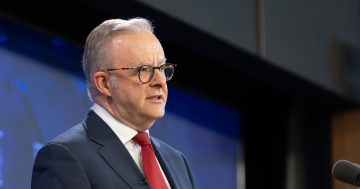
Anthony Albanese in Singapore at an LNG facility. He will next travel to Brunei and Malaysia for fuel security talks. Photo: PMO.
Anthony Albanese will be headed to more countries in South-East Asia this week in the hope of shoring up fuel security for Australians.
The Prime Minister will travel on Tuesday (14 April) to Brunei and Malaysia as part of the Federal Government’s efforts to work with regional partners to maintain what it describes as the two-way flow of energy supplies, fertiliser and other critical goods.
It follows a non-binding agreement reached with Singapore’s Prime Minister Lawrence Wong for his country not to cut petrol supplies to Australia.
Both countries agreed to keep sending the other fuel and liquefied natural gas throughout the fuel crisis due to the Middle East war.
Mr Albanese’s visit to Singapore didn’t, however, result in any extra fuel supplies being announced for Australia.
The PM will now travel between 14 and 17 April to Bandar Seri Begawan, Brunei Darussalam, and Kuala Lumpur, Malaysia.
“Engaging with critical regional partners such as Brunei Darussalam and Malaysia will help ensure Australia’s energy supply remains secure during times of uncertainty,” Mr Albanese said.
“We are taking every step to reinforce relationships and engage with key partners to keep our fuel supply flowing.
“My government is continuing to take every practical action to shield Australians from the impact of the war in the Middle East.”
In Brunei, Mr Albanese will have an audience with Sultan Haji Hassanal Bolkiah to discuss energy, food security, and other essential goods.
Brunei supplies 9 per cent of Australia’s diesel imports, and 11 per cent of fertiliser-grade urea imports.
Australia is a key supplier of food and agricultural products to Brunei Darusalam.
In 2023, Australia and Brunei became Comprehensive Partners, committing to work more closely on energy, climate change, food security, and economic ties.
In Malaysia, Mr Albanese will meet the Prime Minister Anwar Ibrahim to discuss the supply of fuel and other critical goods between the two countries.
Malaysia is Australia’s third-largest source of refined fuel and supplies 10 per cent of Australian imports of fertiliser-grade urea. Australia supplies 95 per cent of Malaysia’s imported natural gas.
The PM said that as Comprehensive Strategic Partners, Australia and Malaysia will continue to work closely to ensure the continued flow of essential supplies, including fuel.
The Prime Minister Albanese will be joined by Foreign Minister Penny Wong, who will meet with Brunei’s Second Minister of Foreign Affairs, Erywan Yusof, and Malaysia’s Minister of Foreign Affairs, Mohamad Hasan.
She will then travel separately for meetings with counterparts in Singapore.
“Working with our regional partners matters more than ever because energy security in our region is a shared challenge,” Senator Wong said.
“We’re continuing to engage closely with countries in our region to support the flow of essential goods like petrol, diesel and fertiliser.
“We know that global supply challenges will be with us for some time, which is why we are focused on supporting Australians through this difficult period.”
Senator Wong also commented on Sunday on the stalled negotiations in Islamabad between the United States and Iran.
“It is disappointing that the Islamabad talks between the United States and Iran have ended without agreement,” the Foreign Minister said.
“The priority now must be to continue the ceasefire and return to negotiations. We continue to want to see a swift resolution to this conflict.
“Any escalation in the conflict would impose an even greater human cost and further impact the global economy.”
Following talks in Pakistan, US Vice-President JD Vance said in a press conference that the two countries had not reached an agreement.
“I think that’s bad news for Iran much more than it’s bad news for the United States of America” he said.
Iran’s state-run news has reported that the US’s “excessive demands” were the cause of no agreement being reached in the negotiations.
“The Iranian delegation negotiated continuously and intensively for 21 hours in order to protect the national interests of the Iranian people; despite various initiatives from the Iranian delegation, the unreasonable demands of the American side prevented the progress of the negotiations.
“Thus the negotiations ended,” Iranian state broadcaster IRIB reportedly said on Sunday.
Overnight, US President Donald Trump threatened to blockade the Strait of Hormuz as a resut of the failed talks.
Original Article published by Chris Johnson on Region Canberra.