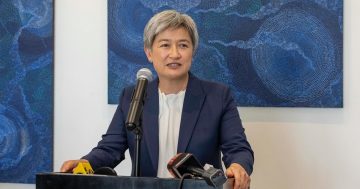
Prime Minister Anthony Albanese says Australia has called for a de-escalation of the Middle East War, and he is pleased that this is now occurring. Photo: Michelle Kroll.
Anthony Albanese has welcomed the announcement of a two-week ceasefire in the Middle East, following an agreement reached between the United States, Israel and Iran.
But the Prime Minister has also expressed concerns about some of the language used by US President Donald Trump during the latest developments in the conflict.
President Trump announced the ceasefire on Wednesday (8 April), saying he had agreed “to suspend the bombing and attack of Iran for a period of two weeks” on the condition that the Strait of Hormuz would be reopened for safe passage.
Iran’s Supreme National Security Council subsequently guaranteed safe passage, in coordination with Iranian armed forces. Iran has also agreed to engage in two weeks of negotiations with the US in Pakistan, starting this coming Friday.
Mr Trump had earlier threatened to strike civilian infrastructure if Iran did not cooperate.
Mr Albanese criticised the President’s statement.
“The potential of damage to civilian infrastructure in Iran was an extraordinary statement to make,” the PM said during a Sky News interview.
“And then also, the impact that would have arisen from an escalation with an Iranian response would have led to greater global economic damage.
“We’re already seeing a substantial impact of a war which is on the other side of the world, but is having an impact on Australians here, like it is on citizens throughout the world.”
The US President had even tweeted “’a civilisation will die tonight’” if Iran did not open the Strait of Hormuz.
Mr Albanese suggested such language was not becoming of a US President.
“I don’t think it’s appropriate to use language such as that from the President of the United States. And I think it will cause some concern, which is there,” the Prime Minister said when asked about the comments.
Asked if the President would be guilty of war crimes if he followed through with his threat, Mr Albanese tried to focus on the positive.
“It’s a long step between a tweet and that suggestion,” he said.
“What we have called for is a de-escalation, and that is what has occurred. And that’s a good thing.”
The PM stressed that the relationship between Australia and the US remained strong.
“We are two great democracies, and that will continue into the future,” he said.
The Prime Minister and Foreign Minister Penny Wong issued a joint statement welcoming the news of the ceasefire and the agreement to negotiate over the coming fortnight.
“The Australian Government has been calling for de-escalation and an end to the conflict for some time now,” they said.
“Iran’s de facto closure of the Strait of Hormuz, coupled with its attacks on commercial vessels, civilian infrastructure, and oil and gas facilities, is causing unprecedented energy supply shocks and impacting oil and fuel prices.
“We have been clear, the longer the war goes on, the more significant the impact on the global economy will be, and the greater the human cost.
“Australia has been working with international partners to support diplomatic efforts to reopen the Strait of Hormuz, so critical supplies can flow to those who need them.
“We thank and support the work of negotiators, including Pakistan, Egypt, Türkiye and Saudi Arabia, in advancing de-escalation efforts.
“Australia wants to see the ceasefire upheld and a resolution to the conflict. We continue to call on all parties to uphold international humanitarian law and protect civilian life.”
Opposition Leader Angus Taylor has also welcomed news of the ceasefire.
“We certainly hope and pray that it sticks because we want to see peace in the Middle East, but we also want to see oil tankers moving through the Strait of Hormuz, and this is crucial for prices at the bowser,” he said.
But the Opposition drew short of criticising the US President’s choice of language to threaten Iran. He simply said he wouldn’t have used the same words as Mr Trump.
“But the outcome is what I want to see,” the Opposition Leader said.
“The outcome that is imperative here is that we have an opening up at the Strait of Hormuz, that we have oil and refined products moving through, coming to Australia, putting downward pressure on prices at the bowser.”
Original Article published by Chris Johnson on Region Canberra.