

The ACCC has released its latest quarterly petrol monitoring report. Photo: Michelle Kroll.
Canberra motorists are paying more for petrol than most of their counterparts in Australia’s five largest cities.
And while petrol prices are on the way up across Australia, motorists are generally paying less right now than they did throughout most of last year.
The Australian Competition and Consumer Commission (ACCC) has released the latest quarterly petrol monitoring report, showing retail petrol prices across the five largest cities – Sydney, Melbourne, Brisbane, Adelaide and Perth – were higher in the September quarter 2025.
Average petrol prices were also higher in Canberra, Hobart and Darwin, and on average across more than 190 regional locations the ACCC monitors.
Quarterly average retail petrol prices in Canberra sat at 182.6 cents per litre (cpl) compared to Darwin at 182.5 cpl. Both were higher than the combined average across the five largest cities – although on an individual city basis, Melbourne and Brisbane were slightly higher on average.
Prices in Hobart were lower at 176.9 cpl.
Grouped together, prices across the five largest cities averaged 178.8 cpl, an increase of 3.1 cpl from the previous quarter.
The ACCC said the average prices in the September quarter 2025 largely reflected higher international prices for refined petrol and increases in other wholesale costs and margins.
“Although average prices were higher in the September quarter, they were lower than price levels throughout most of 2024,” Commissioner Anna Brakey said.
“The increase in international refined petrol prices was partially offset by a higher quarterly AUD-USD exchange rate, which made the international cost of refined petrol less expensive in Australian dollar terms.”
Other wholesale costs and margins include import and wholesale related costs such as international shipping, the quality premium for Australian fuel standards, insurance and loss, local wharfage and terminal operation, as well as wholesale marketing margins.
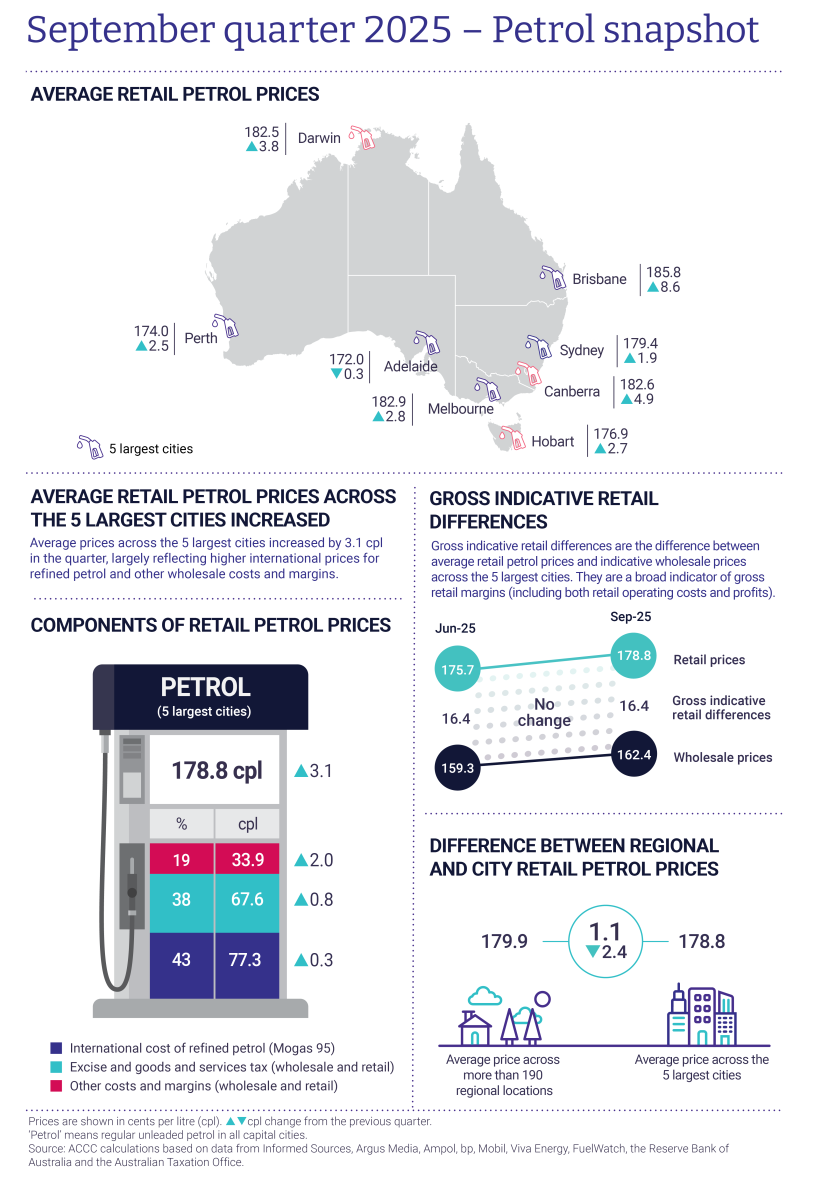
The ACCC’s petrol report snapshot shows comparisons of average retail prices across Australia. Image: ACCC.
The ACCC’s report notes gross indicative retail differences are a broad indicator of gross retail margins and include retail operating costs and retail profits.
Gross indicative retail differences represent the difference between average retail petrol prices and indicative wholesale prices.
Quarterly average petrol gross indicative retail differences were 16.4 cpl across the five largest cities, the same as in the previous quarter.
Diesel prices were also higher in the September quarter, with average retail diesel prices increasing in all capital cities.
Across the five largest cities, quarterly average retail diesel prices were 181.8 cpl, an increase of 3.4 cpl from the previous quarter.
The increase in average retail diesel prices was driven by higher international refined diesel prices.
The report notes sales of regular unleaded petrol have been declining in Australia over time as petrol vehicles continue to become more fuel efficient and travel patterns evolve, including more working-from-home arrangements.
“The decline of petrol sales has also been impacted by more battery, hybrid and plug-in vehicles on the road,” the report states.
“The number of registered battery electric vehicles has increased significantly over the past few years, although in early 2025 they still made up only around 1.2 per cent of total registered vehicles.
“Diesel sales have gradually increased over time, as the number of registered diesel vehicles has grown by more than a million between 2021 and 2025.”
Every Australian state and territory now has a fuel price transparency scheme in place, offering near real-time pricing data and mandatory fuel price reporting requirements on retailers.
“There is often a range of prices available and we encourage motorists to utilise fuel price apps and websites to shop around for lower prices to save some money at the bowser,” Ms Brakey said.
The ACCC has been monitoring retail prices in all capital cities and more than 190 regional locations across Australia since 2007.
On 14 December 2022, Federal Treasurer Jim Chalmers issued a direction to the ACCC to continue to monitor the prices, costs and profits relating to the supply of petroleum products and produce a report every quarter for a further three years.
Original Article published by Chris Johnson on Region Canberra.