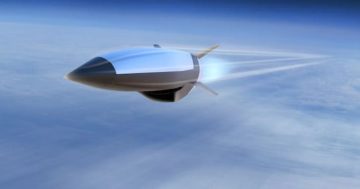
The THAAD system can intercept ballistic missile threats at high altitude more than 100 kilometres from the intended target. Photo: US DoD.
The US Defense Department has announced two agreements to boost production of high-end components for advanced air defence missiles.
The agreements with General Dynamics Ordnance and Tactical Systems and Lockheed Martin come in the face of a high number of Terminal High Altitude Area Defense (THAAD) and Patriot Advanced Capability-3 Missile Segment Enhancement (PAC-3 MSE) interceptors US and Gulf state forces have used against Iranian drones and ballistic missiles.
They follow similar agreements signed in early August with other defence industry companies to expand the production of components for the systems.
The agreements would initiate seven-year procurement contracts to increase production quantities and accelerate delivery schedules for critical missile subcomponents. This will enable the tripling of PAC-3 and the quadrupling of THAAD interceptor production capacity.
A July report from the reputable Center for Strategic and International Studies (CSIS) think-tank estimates the US has expended as much as two-thirds of its entire PAC-3 and more than one-third of its THAAD inventories since it and Israel first struck Iran in February.
CSIS says the US has about 800 PAC-3 MSE missile rounds remaining from a pre-war inventory of more than 2300, while THAAD stocks have dropped from more than 450 to about 270.
Missiles from both systems have had to be drawn from those in Europe and the Pacific, leaving inventories dangerously low in those theatres, both of which are experiencing heightened tensions. The systems have also been supplied to Israel to complement that country’s Iron Dome system.
The missiles themselves cost up to US$5m (A$8m) each, and CSIS says both systems have been largely successful at intercepting Iranian ballistic missiles. It says the US also has several hundred of the older PAC-2 interceptors, although these are less effective against ballistic or hypersonic missile threats.
The shortage has also caused concern in Ukraine, which is running dangerously low on Patriot missiles that had been supplied or donated by the US and European nations. Ukraine has come under increasing missile attacks in recent weeks as Russia continues to experience personnel, equipment and territorial losses in the ground war and its Black Sea fleet.
Similarly, in the face of increasing ballistic and hypersonic threats in the region, the Australian Government undertook in April’s Integrated Investment Plan (IIP) and May’s Federal Budget to accelerate the acquisition of a medium-range ground-based air defence (MRGBAD) system to protect bases, key infrastructure, and deployed forces.
But with the US running short of stocks for its own forces, and the unlikelihood that a local sovereign manufacturing capability could be established anytime soon, Australia’s options in the short-to-medium term may be limited.
While a ceasefire in the Gulf has largely held since April, allowing some missile stocks to be replenished, a resumption of Iranian ballistic missile attacks in recent days following a US strike on Iranian missile positions has caused a further depletion.