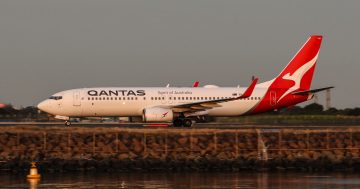
A successful government trial will see the digital Australia Travel Declaration rolled out around the country. Photo: DAFF.
Looking around for a pen on a plane to mark a bunch of crosses on an orange incoming passenger card is a minor frustration no one really wants when arriving in Australia.
Be it visiting tourists or returning Aussies, international travellers just want to get into the country as quickly as possible.
The government has heard the cries and, after a successful trial, is now rolling out digital passenger cards for all travellers to Australia.
In fact, previous Australian governments have been working on this for some years, but it took some doing to get the technology right.
In a collaborative partnership with the Australian Border Force, the Department of Agriculture, Fisheries and Forestry and Qantas, the Australia Travel Declaration pilot program has delivered a digital alternative to the paper incoming passenger card.
A trial launched in October 2024 has resulted in more than 450,000 passengers on eligible inbound Qantas flights into Brisbane, Sydney, and Melbourne successfully using the digital Australia Travel Declaration.
That pilot, in partnership with Qantas, will now be introduced in other capital cities, including Perth and Adelaide, before the end of this year.
The Australia Travel Declaration will then be rolled out to all international airports and seaports in a phased approach over the next 12 to 18 months.
It will initially be accessible via a webform option to continue collaborating with industry to co-design in-app capabilities.
The Federal Government will provide $56.1 million over four years for traveller modernisation at airports across Australia.
Tourism Minister Don Farrell said filling out paper forms will soon be a thing of the past for millions of travellers to Australia.
“Making arrivals simpler and quicker means visitors can spend less time filling out forms and more time enjoying everything Australia has to offer,” Senator Farrell said.
“This is a win for tourists and a win for our tourism operators, helping make Australia an even easier and more welcoming place to visit.”
“Making the arrival process easier is a priority for our tourism industry.”
The broader rollout of the Australia Travel Declaration will reduce manual processes for passengers and enable the digital collection of information in advance.
It will also improve data quality for risk assessments and enable rapid updates and management of global risks and events, such as biosecurity outbreaks.
Home Affairs Minister Tony Burke noted that the initiative is not just for international visitors but will also make travelling easier for Australians.
One aim, he said, is to meet passenger expectations for a biometric-enabled, seamless digital border experience.
The minister acknowledged that it has taken some time, over the past and present governments, to get it right.
“There were a couple of false starts under the previous government, I think in 2016, and then a little bit later they tried it again, and the technology didn’t quite work,” he said.
“This time we’ve spent a good length of time, trialling it effectively through the Qantas app, initially for people coming from New Zealand and then for Qantas flights along the east coast.
“We’ve been trialling it, and it’s working, and so we’re ready now to be able to start the rollout.
“[It will] take quite a few months as the rollout goes on, but it’ll go to airports across the country. It’ll end up being there for cruise liners as well.
“A lot of us have been in a situation at the end of a flight when the cards get handed out, and you’re not always at your best at the end of a flight and, you know, people are scrambling around – ‘Who’s got a pen? What, what’s the name of this flight again? What on earth is the phone number of my next of kin? What’s the address of the hotel that I’m meant to be staying at?’
“It all gets thrown at the end of a flight, and then the fact that you’re dealing with pieces of cardboard just slows the process down anyway.”
With the digital card, information can be entered online starting 72 hours before boarding a flight (upon arrival at the departing airport, which is most likely for most). This results in a QR code being issued.
Mr Burke said it will make arriving a more seamless experience for most travellers.
“When people arrive in Australia, I want them out of the airport and experiencing the best place in the world as fast as possible,” the minister said.
“Traveller modernisation is essential to Australia’s prosperity and national security.
“Visitors and Australian travellers alike will be able to take advantage of a seamless border process, which integrates into everyday digital life.”
The Australian Chamber of Commerce and Industry welcomed the government’s announcement, saying it will speed up the arrival process for passengers.
ACCI’s tourism executive chair, John Hart, said the chamber has “long called for the eradication of the paper arrival card” as it slows the arrival process for tourists and Aussies coming home.
“We are glad the government has listened and reacted,” he said.
Original Article published by Chris Johnson on Region Canberra.