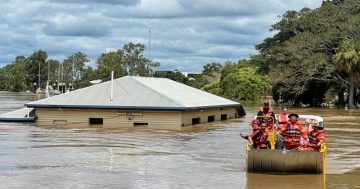
Foreign Minister Penny Wong says the Federal Government is doing everything it can to locate Australians missing in Nepal and to support their loved ones. Photo: Michelle Kroll.
The number of Australians unaccounted for in the deadly Nepal-Tibet flash flood has now risen to 43.
The disaster that struck last week wiped out villages and has already claimed more than 800 lives, according to local authorities in Nepal, with the death toll expected to rise.
More than 3000 people, locals and international visitors, remain missing following the huge glacier collapse in the Himalaya on Wednesday that swept the flood into the Gyirong Port, a major land border crossing between Nepal and China.
The Australian Government has dispatched personnel to help, but they have so far not been able to access the Nepal flood zone.
Assistant Foreign Minister Matt Thistlethwaite confirmed on Monday morning (31 August) that numerous obstacles are delaying Australian officials.
He said roads to the zone were cut off and telecommunications were down.
“There have been about eight power stations that have been affected as well, so it’s very difficult to get into the area,” he told ABC News Breakfast.
“We’ve got 12 additional consular staff that we’ve sent to the region to assist our post on the ground there to try to recover those Australians as quickly as possible.
“We’re doing everything we can, working around the clock to try to locate those missing Australians.”
Australia has also offered support to the Chinese government, but that offer has so far been rejected. There are six known Australians missing on the Chinese side of the border.
The Department of Foreign Affairs and Trade (DFAT) has received more than 650 calls regarding the disaster.
The Australian Government has committed a further $3 million in humanitarian assistance to the area, bringing the total to $8 million.
Foreign Minister Penny Wong said on Sunday that the Federal Government continues to do everything it can to confirm the welfare of those missing and to support their loved ones.
“This is an extremely anxious time for their families and loved ones,” Senator Wong said in a statement.
“They are understandably desperate for news, and our thoughts are very much with them.
“There are now 12 Australian response team personnel – including crisis response, consular officers and Australian Federal Police – in Kathmandu to support the crisis response, in addition to staff already there.
“The extraordinary scale of this disaster, conditions on the ground and the remoteness of the affected region means there are immense challenges for rescue and recovery efforts.
“Communities in affected areas face heightened risks following the floods, while damage to roads and bridges has complicated the delivery of emergency assistance.”
The government of Nepal has requested emergency supplies including hygiene kits and solar lighting solutions.
Australia’s additional assistance includes $2 million to provide these supplies and other humanitarian support, to be delivered by the Australian Defence Force.
The Royal Australian Air Force (RAAF) is transporting the first of these supplies from Queensland.
Senator Wong said there has been an overwhelming response from the Australian people to the Emergency Action Alliance appeal, with public donations alone reaching $1.4 million.
On Saturday, Senator Wong took to social media to express her delight that one Australian had been safely located.
“Cara Severino has been safely located by Australian consular officials in Nepal,” the minister said on X.
“I spoke directly with her a short time ago and am very pleased to know she is safe.
“This is a rare piece of positive news amid a disaster that has brought immense loss and uncertainty.
“While this is a welcome development, there remain grave concerns for the other Australians who remain unaccounted for, and our officials are continuing to work closely with local authorities to locate and assist those affected.”
Many of those killed and missing in the flood were en route to the high-altitude Tibetan pilgrimage site Kailash Mansarovar, which is regarded as holy by Hindus and Buddhists.
Early reports suggested that a 4.4-magnitude earthquake had triggered glacial collapse, but the US Geological Survey subsequently ruled that out.
It said in a statement: “This event was initially reported as a magnitude 4.4 earthquake. Additional analysis of nearby seismic stations, long-period seismic waves, and satellite imagery led to the determination that the seismic event was instead a glacial collapse and debris flow, and that no earthquake had occurred.”
Original Article published by Chris Johnson on Region Canberra.