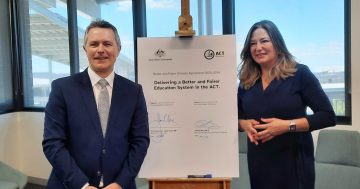
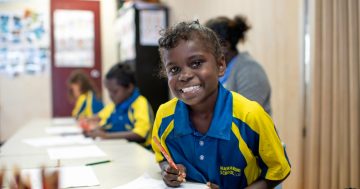
NSW-based students have long been able to be educated in Canberra – now the state government could be billed for it. Photo: Michelle Kroll.
The NSW Government could soon get a bill asking for millions of dollars to compensate the Territory for the education cross-border students are receiving in Canberra’s public system.
All MLAs agreed to the motion brought by interim ACT Greens leader Jo Clay, calling on the ACT Government to fully cost the Territory’s spending on NSW students in primary and secondary schools and to invoice the NSW Government on a cost-recovery basis from Term 3 onwards.
Ms Clay pointed out that such an arrangement already existed for health and said it should exist for education as well.
“It’s not possible to balance every dollar perfectly, [but] for education, we haven’t even made an attempt [to recover costs],” she said.
“The ACT gets no funding from NSW for NSW students in our schools, and that imbalance is structural, it’s persistent and it’s growing.”
The Commonwealth Grants Commission (CGC) does provide the Territory with some funding to cover the cost of educating non-residents, but the full extent of that allowance is unclear.
Ms Clay said clarity was needed to understand not just the operational cost of educating NSW students, but also the infrastructure and maintenance wear and tear.
“It’s about ensuring that when services are provided, the costs … are shared properly,” she said.
“It’s about making sure we don’t ask ACT ratepayers to cover the costs of NSW services.”
Ms Clay estimated that about 1000 NSW students attend ACT public schools every day. The ACT Government spent $22,265 per public school student in 2023-24 (before factoring in subsidies to private schools).
She said this meant the Territory was spending about $23.4 million educating students from across the border.
“$23.4 million is quite a lot of money for us to leave on the table,” Ms Clay said.
“The ACT Government must invoice NSW on a cost recovery basis, including capital costs and depreciation, for every NSW student attending an ACT-funded educational institution.
“Canberrans deserve a government that fights for fair funding, not one that leaves money on the table.”
Shadow Education Minister Elizabeth Lee agreed.
She questioned why the ACT Government had just accepted what it had been getting through the CGC and hadn’t explored other options sooner.
“In the 10 years that [Yvette Berry] has been education minister, she has not done one thing to discuss reimbursement or even a contribution from the NSW Government for cross-border enrolments,” Ms Lee said.
“This is unfair. It’s that simple.”
Education Minister Yvette Berry welcomed any opportunity to investigate how to better support Canberra’s education system.
But she also wanted to clarify a few points.
Ms Berry pointed out ACT families were allowed to send their children to NSW schools – and in fact the 2025 school census showed there were 170 Canberra children in NSW public schools (compared to 979 NSW students in ACT public schools).
Cross-border enrolments also occur between NSW and Queensland and between NSW and Victoria, but no pay arrangements have been established between those states.
NSW residents have access to six public primary schools, five high schools and three college “pathway” schools in Canberra, along with non-government options.
“I acknowledge that the ACT’s smaller size means that cross-border enrolments proportionally have a greater impact on the ACT compared to other states and territories,” Ms Berry said.
The Commonwealth’s Fairer Schools funding means the ACT Government receives funding based on enrolments rather than a student’s home address, but it is funding the resourcing share for NSW-based students.
Ms Clay’s motion means the ACT Government will need to report back and table all correspondence and representations made by ministers and officials to the NSW Government on this matter by 15 September.
Original Article published by Claire Fenwicke on Region Canberra.