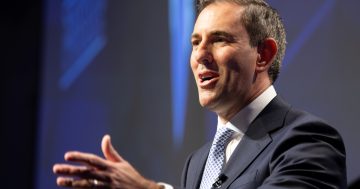
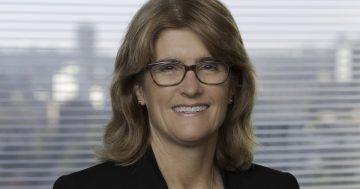
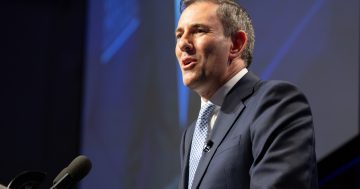
Jim Chalmers and Katy Gallagher: it’s a tough time to be finalising a Budget. Image: Screenshot.
It is widely anticipated that the Reserve Bank of Australia will deliver a third consecutive interest rate rise today (5 May).
Financial markets are giving it an 80 per cent chance.
Treasurer Jim Chalmers will stand up later in the day to try and explain why it’s not his fault; that it’s the current global uncertainties – the Middle East war and the closure of the Strait of Hormuz impacting oil prices – sparking the RBA move.
Maybe the Treasurer will use the term that’s suddenly getting traction in some economist circles, “the Hormuz hike”, to justify the state of inflation in Australia.
RBA Governor Michele Bullock will also stand up this afternoon to explain her board’s decision, but she will do it without the political spin.
Who knows, the Treasurer (and Australian mortgage holders) might get lucky and escape another interest rate rise today, but the chances of that are slim.
A week from today, Chalmers will deliver his fifth budget, which is shaping up to be the one the nation is most keenly anticipating.
Australians are bracing for even more bad news.
The Treasurer is already touting it as his “most responsible” budget to date.
That’s undisguised code for “it’s gonna be a tough one”.
“This will be a really responsible budget focused on resilience and reform,” Chalmers said on Monday.
“There will be a productivity package, there will be a tax reform package, and there will also be a very substantial savings package as well … The budget will be calibrated for the conditions, but it will also still be consistent with our ambitions.”
The Treasurer and the Finance Minister, Katy Gallagher, have also stressed that savings will be found in the budget across all government portfolios.
Every public service department will feel the pinch.
That can only mean that, by extension, every Australian will also notice it as government services tighten and/or disappear, and a string of social service benefits and payments get “adjusted”.
Some of those negative adjustments have already been announced.
Data from the Australian Bureau of Statistics released last week showed inflation in Australia had risen to 4.6 per cent in the year to March, the highest in two and a half years.
Most of that almost complete percentage point jump could be put down to the huge spike (30 per cent plus) in petrol prices in March.
Chalmers has ruled out using the budget to extend the 26-cent fuel tax cut beyond the end of June.
Mortgage holders are likely to be whacked with more pain today if there’s a third straight interest rate hike, edging closer to an extra $300 a month for many since the rises began in February.
It is almost exactly 12 months to the day since last year’s federal election – and how things have changed.
Labor’s euphoria over its trouncing victory has been forced to give way to sobering developments that Anthony Albanese clearly wishes had not happened on his watch.
The Bondi terrorist attack in December and this year’s Middle East war under the direction of an increasingly erratic US President were not things the Prime Minister anticipated or welcomed.
The sudden surge of One Nation’s popularity and the crumbling of the Coalition vote have also thrown a curveball or two.
None of this, however, gives Australians any comfort when they feel financial pain.
Neither is the level of government spending they have seen over the past few years.
The Opposition has found its voice on government spending and is cleverly linking it directly to voters’ hip pockets.
Australians are hurting, shadow ministers repeat ad nauseam, because Albo and Chalmers’ spending has been out of control.
This budget looks like that spending might be coming back to bite the government where it hurts.
Here’s what the Treasurer has to say on that point.
“First of all, we need to remember that government spending is nowhere near the primary driver of prices in our economy, that public spending is a much smaller proportion of activity than activity in the private sector,” he said on Monday.
“From time to time, people want to pretend that the only thing that matters is government spending, which I don’t remember them saying when inflation was coming down quickly and interest rates were being cut.
“But leaving that to one side, we’ve got a combination of persistent and temporary pressures when it comes to inflation.
“We’ve got a very severe price impact in petrol from the war in the Middle East, which drove that inflation spike in March in the numbers that were released last week.
“We weigh up all of these pressures, temporary and persistent, whether it’s pressures on inflation, pressures on growth, pressures on the budget.
“Every budget is carefully calibrated to the conditions. This one will be calibrated to the conditions, but it will also be ambitious.”
It sounds a little too much like the government trying to convince itself that its spending hasn’t been overly rampant.
Next week’s budget – and today’s RBA announcement – might be saying otherwise, however.
Original Article published by Chris Johnson on Region Canberra.