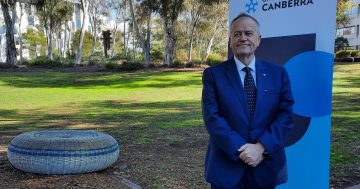
New CIT Board chair Tom Rogers and deputy chair Kylie Walker with Skills, Training and Industrial Relations Minister Michael Pettersson, at left. Photo: Ian Bushnell
Canberra Institute of Technology has landed two big fish for its board as the institution navigates away from a troubled past into an exciting future – one is arguably the most trusted public servant of our times and the other a powerhouse in science and technology.
Former Australian Electoral Commission boss Tom Rogers will take over from current chair Kate Lundy, who is leaving after six years in the role, steering CIT through possibly its darkest period, the Leanne Cover corruption scandal.
His deputy will be Professor Kylie Walker, Australian Academy Of Technological Sciences & Engineering CEO and a highly influential STEM education advocate.
Together with new CIT CEO Dr Margot McNeill, the leadership team represents a clear break from the past with an eye firmly fixed on the future.
They will play a central role in driving the initiatives of the National Skills Agreement and strengthening CIT’s capacity to deliver the skills, innovation and industry partnerships that will shape a resilient, future-ready workforce for Canberra.
Both are committed to earning the trust of staff, students and the community in an organisation that not only has had to endure the ignominy of the contracts affair and ACT Integrity Commission investigation but ongoing budget issues.
While acknowledging the work of Ms Lundy and the board to right the ship, they said earning trust would be a constant process.
“I’ll be looking forward to listening very clearly to everyone, all the stakeholders in the community and doing what I can to build on the levels of trust the current board have been working on over the last few years as well,” Mr Rogers said.
“I know that this is such an important institution for the Canberra community and I’m taking that very seriously.”
Mr Rogers has runs on the board when it comes to trust. By the time he finished at the AEC in 2024 it was rated the most trusted government agency. But that took 15 years to achieve.
Professor Walker said building trust and building relationships was a job that never ended.
“You have to keep investing in it and I’m looking forward to working with Tom and the board and team here at CIT to continue to invest in those relationships to be strong and fruitful for everybody who’s connected with CIT,” she said.
Australia faces skills pressure everywhere but both believe Vocational Education and Training (VET) and organisations like CIT were crucial to maintaining traditional trades and delivering the workers and business people the new economy will need.
Mr Rogers said there were huge opportunities in areas such as artificial intelligence, cybersecurity and quantum computing.
He said there were a new set of skills that industry was going to need and CIT needed to be nimble and agile to deliver these, as well as those that Canberra needed to exist and live.

Outgoing CIT board chair Kate Lundy with Professor Walker, Mr Rogers and Mr Pettersson. Photo: ACT Government.
Professor Walker said VET was essential to meeting the needs of today and tomorrow.
“I actually think that it is a non-negotiable to respond to the needs of the Australian economy now and the way that we are organising our society for the future, if we are to meet the demands of the energy transition, if we are to appropriately care for our ageing population, if we are to realise the potential,” she said.
“Australia has enormous potential and the ACT specifically has enormous potential to invest in the modern manufacturing technologies that are going to create a more homegrown industry in a way that we probably haven’t had the opportunity to do before.”
Professor Walker said all of those things relied on the skills taught through vocational education.
“We’re already short of the engineering technicians that we need for the energy transition and there’s no other place to make those skills happen to grow that workforce,” she said.
She said the exciting frontier areas included robotics, autonomous vehicles, batteries and modern or advanced manufacturing involving innovative technologies.
“We’re only just starting to explore the potential for that [modern manufacturing] and the beauty of that and when you marry it with the circular economy on a micro level it can be very localised and it can open up a lot of new industrial potential for small cities like Canberra,” she said.
Both are on board with the CIT vision for life-long learning supporting multiple careers and seamless movement between VET and universities.
Professor Walker, whose career has taken many turns, said the pipeline or single track model was no longer appropriate for today’s economy.
She prefers the subway model, where people could go down and take a different track and then come back up again and build different careers through training at any stage of life.
That also applied to non-career, community connection courses for fulfillment and enrichment as well.
Asked whether industry needed to contribute more to VET, Mr Rogers said budgets were tight everywhere and CIT had to be good stewards of its funding but the board was exploring other ways of doing business.
“I wouldn’t want to put words in the minister’s mouth, but I’m sure that he’d like industry to contribute more from a budgetary perspective,” he said.
Skills, Training and Industrial Relations Minister Michael Pettersson agreed that business needed to step up and this was something he had raised with the Commonwealth.
“As a government we are open-minded to work with industry to help them achieve the goals that they need to achieve for our economy,” he said.
“We can’t do it alone, we want them to come to the table.”
Mr Pettersson paid tribute to the work of Ms Lundy, who had left a lasting legacy and positioned CIT strongly for the years ahead.
“I would like to sincerely thank Ms Lundy for her dedicated leadership and, in particular, for her stewardship of the new Woden campus development,” he said.
Mr Rogers will commence as chair on 31 March with Prof Walker to begin her term on 1 September.
Original Article published by Ian Bushnell on Region Canberra.