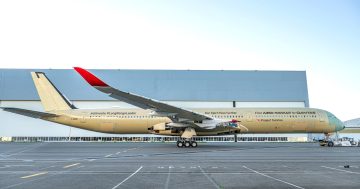
The first A350-1000ULR appropriately registered F-WULR lifts off from Toulouse’s Runway 14R on its maiden flight on 2 June. Photo: Airbus.
The first of 12 Airbus A350-1000ULR airliners for Qantas has made its maiden flight at the manufacturer’s Toulouse facility in southern France.
The first flight of MSN707 – the 707th A350 to be built and appropriately carrying the temporary F-WULR registration – saw the aircraft depart Toulouse to the south at 12:30 pm local time on 2 June. After flying over the Pyrenees and then north-west overhead Bordeaux, it completed several wide circuits off the west coast of France before returning to land at Toulouse at 3:43 pm.
The flight was conducted six months after the aircraft first broke cover at Toulouse, and just a day after the unpainted aircraft successfully completed high-speed taxi tests and two aborted take-offs designed to verify that the engines can operate at full power and that the brakes can stop the aircraft at high speed.
The ULR – for ultra long range – is the latest variant of the successful large twin-engined airliner, and combines the fuselage of the stretched A350-1000 with a new 20,000-litre integral centre fuel tank designed to provide an additional 1800 km of range for nonstop flights of up to 22 hours.
Compared to other long-range airliners which typically use optional container-like auxiliary fuel tanks in the aircraft’s hold, the A350-1000ULR’s integral tank forms part of the aircraft’s fuselage structure. Therefore, the aircraft will need to be certified separately by European authorities as a subtype of the A350 family.
The certification work will include a two-month series of proving flights designed to demonstrate the airworthiness of the new integral tank, and to validate the aircraft’s claimed range and performance figures.
An Airbus statement says, “During the first flight the crew carried out general aircraft performance checks and tested the new fuel system architecture. This marks the start of a two-month flight test campaign to certify the modifications.
“In addition, a new galley air cooling system will also be certified, which features lighter and more efficient refrigeration units for very long flights. The ventilation and temperature control of the cabin will also be thoroughly tested.”

The 3-hour-and-13-minute flight was conducted over southern France and the Bay of Biscay. Image: Flightradar24.
The first flight comes just a week after Airbus informed Qantas that its first of 12 A350-1000ULRs won’t be delivered until the second quarter of 2027 instead of late 2026 as had been hoped, leading to a six- to eight-month delay to the airline’s plans to commence nonstop Sydney to London and Sydney to New York flights under its ambitious Project Sunrise.
Airbus has attributed the delays to unspecified supply chain issues which, considering the aircraft has now successfully flown, may be related to the aircraft’s unique low-volume cabin configuration.
The aircraft which conducted the first test flight will actually be the second to be delivered to Qantas, as it is fitted with flight test equipment and will need to be reconfigured before being fitted with its airline interior.
Industry insiders have hinted that one of the first two ULRs will be painted in a special scheme, possibly a new First Nations art scheme similar to those applied to Qantas Boeing 747s in the past, and to current Boeing 737s, 787s and an Airbus A220.
Qantas has specified its ULRs with just 238 seats, comprising six first, 52 business, 40 premium economy, and 140 economy class seats. By comparison, the A350-1000 that Etihad flies between Abu Dhabi and Sydney seats 371 passengers. Qantas also has 12 A350-1000s on order in a non-ULR configuration.
The cabins have been developed from the ground up in collaboration with Australian industrial designer David Caon and experts from the University of Sydney’s Charles Perkins Centre, which includes sleep scientists looking to minimise jetlag using customised lighting design and timed meal services.
Qantas is the only airline to have ordered the A350-1000ULR to date, and Airbus executive vice president international Wouter Van Wersch told Australian media earlier this year airlines were watching closely to understand the economics of Sunrise.
“I can tell you there are several airlines that are very interested because having the capability to fly for up to 22 hours and 18,000 kilometres – it’s not only Qantas that would love to do so,” he said.
The A350-1000ULR is the fourth of five versions of the popular A350 to be developed, the others being the original A350-900; the A350-900ULR which Singapore Airlines flies on what is the world’s longest route, between Singapore and New York; the A350-1000; and the A350 Freighter which is in development.
Airbus said that as at the end of April, 1579 A350s were ordered by 68 operators, and more than 700 were in service.

Qantas is the only airline so far to order the A350-1000ULR. Photo: Airbus.