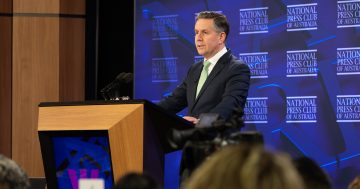
The Australian Government will seek to limit NDIS growth to 5 per cent a year. Photo: NDIS.
Further cuts to the National Disability Insurance Scheme will be “easily the most important part of the savings package” in next month’s federal budget, according to Treasurer Jim Chalmers.
Fresh back from his visit to Washington and talks with finance ministers from around the world, the Treasurer said the “prevailing vibe” from those discussions was a sense of frustration at how the war in the Middle East is impacting the global economy.
But he said the Australian federal budget on 12 May will be focused on reforms and resilience.
One of those reforms will be to the NDIS, with Dr Chalmers saying the government will find more savings from it as it seeks to limit growth to about 5 per cent.
“We need to make sure that it is sustainable and that’s what our efforts are all about,” he said.
“This has been a really big part of our pre-budget deliberations.
“It is easily the most important part of the savings package that we will present on budget night.”
The Treasurer said the scheme was not running as Labor had intended it to and hinted that the states and territories might need to shoulder more of its costs.
There has been a high level of angst among state and territory governments over the potential to shift the NDIS’s parameters.
“We work with the states and territories in good faith, and there are big sums associated with many of these policies, so we understand that these conversations can be difficult,” Dr Chalmers said.
“We all want to do the right thing here. I’m a huge believer in the NDIS, and it’s one of the reasons that we can be proud of how we support each other in Australia.
“But in order to make sure that it is sustainable into the future, we have to deal with some of these escalating costs.”
The Treasurer will be discussing the NDIS with his state and territory counterparts on Tuesday afternoon (21 April).
Health Minister Mark Butler will be delivering more details about the government’s plans for the NDIS when addressing the National Press Club on Wednesday.
One possible outcome is that the state and territories could be offered more federal money if they sign up to Mr Butler’s Thriving Kids scheme, which he announced last year to take some of the burden off the NDIS.
Speaking to Sky News on Sunday, shadow health minister Anne Ruston said that Thriving Kids was a problem for the government and its relationship with the states and territories.
“One of the great challenges is that the Minister, Mark Butler, went out over a year ago and flew a kite around a new program called Thriving Kids without actually speaking to the states and territories,” Senator Ruston said.
“I think there is a very serious conversation that needs to be had with the states and territories about them taking greater responsibility for the lower-level supports, the old supports that used to be in place before the NDIS, which was community support.
“But once again, the Federal Government has front-run this, caused great anxiety and actually hadn’t done their homework before they made these comments.
“So I think it’s time for everybody to get back to the table – Federal Government and all of the state governments and actually design a system that’s fit for purpose to support all Australians who need support, where they need it, in the most appropriate way.”
Senator Ruston said the Opposition has been offering bipartisan support to fix the NDIS’s financial sustainability.
“The first place the minister should be looking to get savings in the NDIS is that they’ve already admitted themselves, between 6 and 10 per cent of funds spent by the NDIS are spent inappropriately, whether that be fraud or because people are abusing loopholes in the legislation,” she said.
“They need to be honest with Australians about what they’re doing.
“Being secretive just creates anxiety. Just come out and be honest with Australians about what you’re doing, and as I said, the Opposition is quite happy to support sensible reforms to make sure the NDIS is sustainable.”
Original Article published by Chris Johnson on Region Canberra.