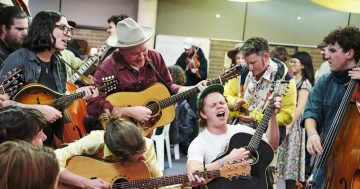
The National Folk Festival is a national institution worth preserving. Photo: Region
This post-Easter opinion column is a call for the Federal Government, state and territory governments, and policy-makers across all jurisdictions to do more to help keep live music events thriving in Australia.
The Easter weekend that has just concluded marked 60 years of the National Folk Festival, with the first of its events staged in Melbourne in 1967 and later moving to Canberra as its permanent home since 1992.
Why is that important to know?
Because it is a national institution that must be kept alive for another 60 years and beyond.
With music festivals falling over right around the country, the National keeps on giving in the face of mounting financial, legal and logistical challenges.
Its footprint at Exhibition Park in Canberra (EPIC) has shrunk over the years due to cost and regulatory constraints, yet it remains a vibrant festival and a highlight of the capital’s cultural calendar.
You can only really call yourself a true Canberran once you have dedicated at least part of your Easter in at least one year to attend at least some of the NFF.
Yet while many locals head to the coast for Easter (another great sign of being a true Canberran), people from across the country make a pilgrimage to the capital for its national festival.
That’s the significance of the National Folk Festival. It is a truly national event that warrants as much money and support as governments can give it to keep it alive and thriving.
Artists love performing at the National, and audiences always leave smiling, energised, and feeling a little better about the world.
Folk festivals are about music and dance, yes, but they are also alive with community spirit, inclusion, politics, dissent and all-around frivolity.
This year’s NFF had one session focusing on the history of the protest song – politics at its finest.
The current troubling global events loomed large over this Easter’s festival, if only by the contrast of goodwill and ‘why can’t we all just get along with each other?’ attitude on display throughout.
All ages, ethnicities and backgrounds were simply having a great time together.
It’s the same for the smaller, community-based festivals in regional areas too.
They bring communities together. But they, too, are struggling to survive in these trying times.
Governments have to step up and stop demanding that festivals apply for funding and grants each year.
Give them some tenure and security. Multi-year funding for established festivals should become the norm.
Cobargo Folk Festival director Zena Arnstrong, along with the president of the Yuin Folk Club, Peter Logue, recently submitted a compelling argument to the NSW Parliament’s inquiry into live music.
“As an organisation dedicated to promoting artistic and cultural engagement for all, we are advocating for increased funding and a structured governmental approach to revitalise the regional live music sector,” they wrote.
“We advocate for inclusive national and state cultural policies, which provide meaningful support not only for regional cultural endeavour but for regional community festivals.
“This network of interlinked activity will underpin support for the reinvigoration of the live music sector in regional Australia.
“These policies would champion regional Australia as a rich source of cultural activity and achievement, enhancing our national cultural story.
“Internationally, governments recognise festivals as essential cultural infrastructure deserving operational investment. The UK’s Arts Council England provides £445 million annually to 985 National Portfolio Organisations, including festivals, through multi-year commitments enabling strategic planning and creative risk-taking.
“We support the creation of a funded plan that includes clear and practical actions, including [the] introduction of multi-year operational funding for well-established, successful community-run folk and roots festivals, recognising their importance in supporting regional artists and the regional live music sector, and the many cultural, social and economic benefits they generate for their communities.
“We aim for a live music policy that acknowledges the importance of growing a supportive regional live music framework, which includes proven community-run folk and roots festivals.”


The same should apply to big and small festivals – in large cities, small towns or far-flung remote locations.
These festivals need more government support.
As a collective community, Australia must do more to keep its live music festivals alive.
And we’re talking music festivals of all genres – folk, rock, blues, jazz, country, classical, world, more.
As the late great jazzman Louis Armstrong once said: “All music is folk music. I ain’t never heard a horse sing a song.”
Original Article published by Chris Johnson on Region Canberra.