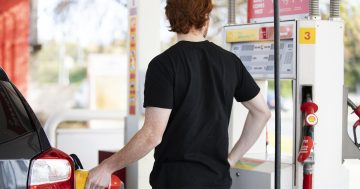
Prime Minister Anthony Albanese says a $10 billion fuel security package will be included in the federal budget. Photo: Region
A $10 billion-plus Australian Fuel Security and Resilience package will be released next week as a new measure in the federal budget.
Its aim will be to ensure energy sovereignty and protect Australia’s energy interests.
The money will go towards securing Australia’s near-term fuel and fertiliser supplies; establishing a permanent government-owned one-billion-litre fuel security reserve; and lifting the Minimum Stockholding Obligation (MSO) by about 10 days for each fuel type.
Of the funding, $7.5 billion will be used to establish a fuel and fertiliser security facility to increase fuel and fertiliser supply and storage by providing financial support, including loans, equity, guarantees, insurance and price support.
Another $3.2 billion will fund the fuel security reserve to increase long-term diesel and aviation fuel supply and storage, in combination with an increase to the MSO.
This will increase Australia’s critical fuel reserves to 50 days, with the fuel security reserve to focus on regional stockouts and supply constraints for essential users in the event of another supply crisis.
Finally, $10 million, to be co-funded with the states and territories, will be directed to support feasibility studies for new or expanded fuel-refining capabilities.
This will build on work with current refinery operators to retain Australia’s refining capability in the decade beyond 2030.
Anthony Albanese said the package will support an overall expansion of Australia’s onshore fuel reserves to ensure at least 50 days of fuel supply and storage of diesel and aviation fuel.
“The government will consult on implementation of the fuel reserve to enable the ability to underwrite or purchase fuel, support storage, and trade stocks as needed to ensure our fuel security during severe or prolonged fuel supply disruption,” the Prime Minister said.
“An additional 10 days of fuel holdings through an uplift to the Minimum Stockholding Obligation for all fuels is also supported in the budget with $34.7 million over four years to support ongoing management of Australia’s fuel security, including government engagement with industry to plan the uplift in fuel holdings.
“It will be achieved by increasing current requirements on refiners and importers holding stocks of aviation fuel, petrol and diesel.”
Mr Albanese said changes will take place progressively over time, backed by support to invest in new and refurbished fuel storage to support the uplift in fuel stocks.
The government will work with state governments to undertake feasibility studies into new or expanded refining capabilities,
More details of the Australian Fuel Security and Resilience package will be unveiled when the budget is delivered on 12 May.
The PM convened another meeting of the National Cabinet on Wednesday (6 May) with state and territory leaders for an update on the National Fuel Security Plan.
He emerged from it, stressing that the Middle East war was having a continued significant impact on the Australian economy, in particular on fuel supplies.
“It is important to recognise the fact that the longer that the Strait of Hormuz is essentially shut, even in spite of the ceasefire being in place for four weeks now, the longer this conflict goes, the greater the impact will be,” he said.
“It’s as simple as that. Our number one priority remains shielding Australians from the worst effects of this crisis.
“And we’re working across with state and territory governments to ensure that the national interest is looked after … So far, we are faring well, and Australia remains at level two of the plan, and we want to stay at level two for as long as possible.”
Energy Minister Chris Bowen provided an update on fuel shipments to Australia since the conflict began.
In April, Australia received 92 shiploads of fuel, which Mr Bowen said was the highest number this year, compared with fewer than 80 in some other months.
“That means we have more fuel in Australia today than we did when the bombing of Iran began,” Mr Bowen said.
“And that’s no small thing. That’s government and industry working together.”
But Opposition Leader Angus Taylor has described Labor’s plan for a one billion litre, government-owned fuel reserve as “too little, too late” and insists the MSO should be at 60 days, not 50, and on the way to 90 days.
“We need more fuel stocks, I’ve said that very plainly,” Mr Taylor said.
“We’ve laid out the costings to do that. The government needs to get on with it.
“They’re not going that far, and that’s disappointing.”
Original Article published by Chris Johnson on Region Canberra.