
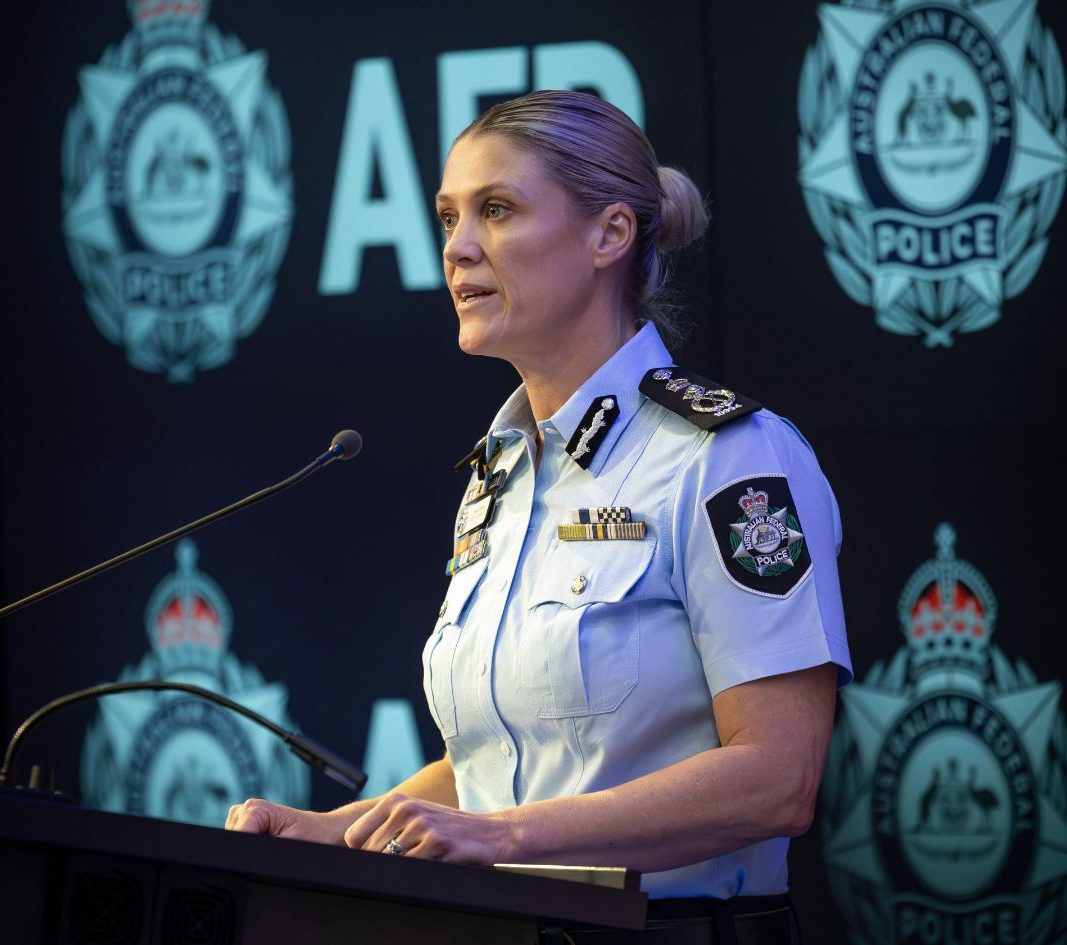
AFP Commissioner Krissy Barrett says too many young Australians are being radicalised online. Photo: AFP.
Twenty-six young Australians have been charged with terrorism-related offences since 2020 through joint counterterrorism operations that include the Australian Federal Police and ASIO.
AFP Commissioner Krissy Barrett revealed the statistic this week during her first appearance at Senate Estimates since December’s Bondi Beach terrorist attack.
The Commissioner said a growing number of young Australians are being radicalised online and taking on worrying extremist and racist views.
There is the very real possibility, she warned, that some minors might soon be declared high-risk terrorist offenders.
“We are also witnessing a trend of lone actors being radicalised quickly – and this creates a more challenging environment for law enforcement,” she said.
“And of significant concern, we are witnessing a growing cohort of people, including youth, who are susceptible to hatred or are attracted to violence.
“Too many influences and influencers are poisoning the minds of our kids and the vulnerable … Being convicted of a Commonwealth terrorism offence can mean individuals are subject to the High Risk Terrorist Offender regime.
“This is where offenders may not be released from prison after they have served their sentence or are monitored by the AFP when they are released back into the community.
“We do not have any young people on the regime yet, and I say yet, because the trajectory of our caseload makes it probable Australia will start having young people declared as High Risk Terrorist Offenders.”
The Commissioner told the hearing that while the AFP is primarily focused on public safety, under her leadership, the force will take a proactive approach to intervene much earlier, including with youth offenders.
More generally, the Commissioner noted that hatred and a willingness to mobilise to violence, which she said often masquerades as a right or freedom to do or say something, is largely directed at federal politicians and high office holders, as well as faith and culturally and linguistically diverse communities.
More lone actors do not necessarily feel the need for an organisational structure to support them.
“We are witnessing the continued rise of individual grievance, including those who are willing to make threats in the online world and then carry them out in the real world,” she said.
“Some of these offenders are not seeking or needing a partner in crime or a network to carry out threats or violence.
“This personalised grievance is often connected to world events, their own sense of injustice or a fixation on people or weapons.
“It may also be that loneliness, or a feeling of exclusion, is driving some of this radicalisation – where individuals who find it hard to make connections go searching for forums or platforms where their polarising views are accepted.”
Commissioner Barrett revealed that national security investigations teams have a standing operation targeting white supremacists. It is called Operation Drakelow.
The AFP also has a standing Operation Antrobus that targets hate preachers, focusing on known and emerging hate preachers.
“We know who many of these malicious manipulators are,” she said.
“And we know some are getting legal advice to push their hate and their radical recruitment drives to the edge of what is lawful.
“It means in some cases, particularly with hate preachers, we have not been able to reach the threshold of charging.
“I want to be clear about my intent. We will use all our available disruption tools because modern policing is not always about arresting and charging; it includes the benefit of disrupting.
“Under my commissionership, we will disrupt and intervene however and whenever we lawfully can.
“Some of our actions will be visible and overt, and other actions will be lawful and covert – and that unpredictability should worry those who are on our radar, and those who will be as we widen our net.
“My advice – if you are one of these groups or individuals – your life will become very uncomfortable.”
Original Article published by Chris Johnson on Region Canberra.