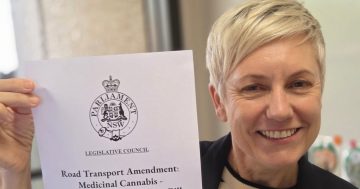
Andrew Braddock wants to establish a statutory defence for medicinal cannabis users who return a positive roadside drug test. Photo: Charles Wollertz.
A suggested law change has called for the ACT to distinguish between presence and impairment when it comes to medicinal cannabis users on the road.
ACT Greens Yerrabi MLA Andrew Braddock introduced the Road Transport (Alcohol and Drugs) Amendment Bill 2026, calling for medicinal cannabis users to be treated under the same legal framework as people prescribed other potentially impairing medications.
“There is a double standard at work here,” he said.
“The purpose of this bill is not to create an exemption for medicinal cannabis users [who are driving], it is to remove the discriminatory treatment they currently face.”
Under the current law, a person prescribed opioids or benzodiazepines (drugs that can cause driving impairment) only faces prosecution if impairment is proven.
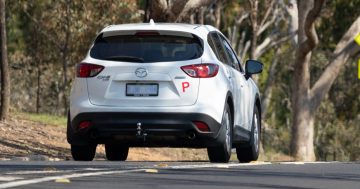
But people using medicinal cannabis can be punished if delta-9-tetrahydrocannabinol (THC) is detected by roadside drug testing.
“The roadside drug test does not measure impairment; it measures presence,” Mr Braddock said.
“These are not the same thing.”
The suggested change would establish a statutory defence for medicinal cannabis users who return a positive roadside drug test.
Mr Braddock argued the current law wasn’t supported by academic medical research into driving impairment arising from THC and was derived from the historical status of cannabis as a prohibited drug.
“The ACT’s current laws simply don’t stack up. Right now, a person can follow their doctor’s advice, take prescribed medicinal cannabis, and still be treated like a criminal, even when they are not impaired and don’t pose a danger to themselves or others,” he said.
“They are not being punished for dangerous driving, but for the presence of a trace amount of a legally prescribed medicine that does not impair driving. Meanwhile, patients taking opioids or benzodiazepines face no equivalent test. That double standard has no scientific basis, and it must change.
“This reform reflects what the evidence tells us: impairment, not mere presence, should be the standard for road safety. Our laws should be based on evidence, not outdated assumptions.”
A defence for lawful medicinal cannabis users is available in Tasmania.
Victoria changed its law to allow magistrates the discretion not to cancel someone’s licence where the only substance detected is a prescribed medicinal cannabis product used as directed. But the criminal charge, fine and criminal record remain.
NSW announced legislation earlier this month to establish a registration-based system with three-strike warnings, with penalties applying on the third detection within two years.
According to the bill’s explanatory statement, the ACT model would differ greatly from the proposed NSW model.
“The NSW approach retains the presence offence and applies it progressively; the ACT Bill inserts a statutory defence that removes criminal liability under the presence and concentration offences for prescribed patients who lawfully used THC,” it stated.
“The ACT Bill does not require patient registration with a transport authority – a barrier that does not apply to patients prescribed opioids or benzodiazepines. The ACT model is more closely aligned with the evidence-based principle of full harmonisation.”
Mr Braddock said it was still important to start aligning with other jurisdictions, given that other states are at least recognising the need to ensure drivers who aren’t impaired aren’t “unfairly charged”.
“It makes no sense for Canberrans to be treated differently simply because they cross a border. You shouldn’t be able to drive legally in Queanbeyan but risk a criminal charge minutes later in Canberra,” he said.
“This reform is about fairness and common sense. People managing serious conditions like chronic pain, cancer, endometriosis, PTSD and multiple sclerosis should not be forced to choose between their medication and their mobility.
“If you are not impaired, you have a valid prescription, and you are taking your medication as directed, you should not be treated as a criminal.”
Original Article published by Claire Fenwicke on Region Canberra.