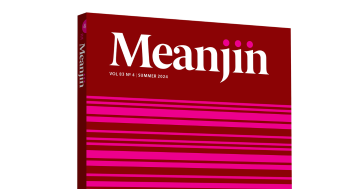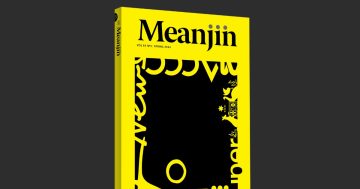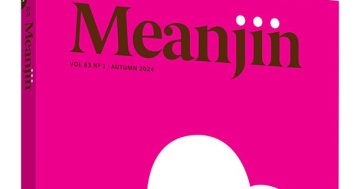


Celebrate 85 years of fiction, poetry and prose in Meanjin 84.4, Summer 2025 with some of the nation’s finest writers as they look back, asking how the Australia they wrote into then has changed. This is the final issue of the literary journal. Photo: Supplied.
It’s a bittersweet occasion as the future and the past meet for the last time in Meanjin 84.4, Summer 2025. This is the end of the line for the literary magazine after the publication of its final issue last month.
Publishing fiction, poetry and prose, Meanjin has reached its 85th year of a distinguished history. The editorial states: “A literary journal is a time capsule, a forecaster, an idea.”
According to editor Esther Anatolitis, a journal is a curious venture.
“A daring; a changeling; a champion,” she writes. “With each editor its politics evolves, always understanding the power of the written word as the greatest power we know.
“… Meanjin was founded in a time of war, with the hope of continuing into a time of peace. Today the words we are compelled to use against the cruelties of tyranny, war and genocide feel more precarious and more policed — just when we need them most. We need these words desperately.
“We need to take refuge in their care and find confidence in their clarity. We need to feel their force: this is the only human force that should ever stop us in our tracks and take our breath away. Only in those moments can we truly begin to envision that time of peace — and commit to making it last.”
After more than eight decades, what has the writing journey meant for the many contributing authors? Has their approach been refined or their expertise expanded? What’s the status of the first piece? How has Australia evolved?
The diverse and influential group of writers includes Peter Craven, Sarah Holland-Batt, John Kinsella, Ellen van Neerven, Bruce Pascoe, Sara M. Saleh and Christos Tsiolkas. They benevolently reflect on their evolution alongside shifts in ethical-creative conversations, the stories we tell ourselves, technology and our institutions.
The feature ”interview” with Meanjin’s founding editor, Clem Christesen (1911-2003), refines that critical perspective.
In Anatolitis’ words: “… expect a fiery set of provocations drawing on decades of editorials that ‘make clear the connection between art and politics’.”
We also hear from Yagarabul Elder Gaja Kerry Charlton, who wrote the first of the refocused Meanjin Paper.
“Honouring cultural sovereignty, we always begin by learning from Elders, and only then do we discover all the reading that awaits us,” Anatolitis writes.
“Gaja Kerry’s ‘Makunschan, Meeanjan, Miganchan, Meanjan, Magandjin’ made an important start by situating ‘meanjin’ in its cultural, historic and linguistic context …”
Channelling the knowledge and care of her powerful matriarchs, Bunuba woman June Oscar’s Meanjin Paper envisions a lasting peace in a future of respect, reciprocity and the daily practice of care.
Oscar touches on numerous points, including the wisdom of dreaming forward, the temporary struggle for recognition, the economics of care and social fabric, regional leadership and global influence and the central role of First Nations women.
In Wanjawurru: Reimagining Australia in 30 years, Oscar admits that when she thinks about the future, “I think about peace — not as a passive state of calm, but as something we build actively: something we create with intention, care and courage.
“Peacebuilding is the deliberate process of establishing and nurturing the conditions that allow peace to grow. It involves addressing root causes of conflict, fostering social justice, and creating inclusive structures that sustain harmony over time. It is the process that I am committed to as I look around the world and see the damage wrought by violent conflict, and divisions and tensions that seethe unaddressed.
“Peace in its truest form is a dynamic process … Right now, we are in a time of fracture. We see polarisation in our communities, aggression in our politics, and despair in our hearts. It feels as if the very foundations of society are shaking beneath our feet …”
Volume 84 No 4 informs us that the future holds endless possibilities. We have a shared responsibility to create an Australia aligned with our deepest values, and work towards a united and inclusive nation.
“Let’s look back with a critical eye — and look forward with renewed curiosity.”
Meanjin 84.4, Summer 2025, editor Esther Anatolitis, Melbourne University Publishing, $24.99