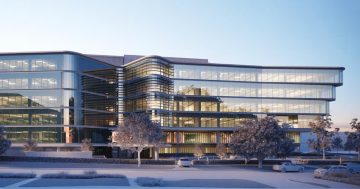
The impressive design boasts open spaces bathed in natural light but staff still have concerns. Images: JPW.
The proposed interiors of the new London Central offices being built on the former law courts car park may look stunning but the public service staff who will occupy them have baulked at key features.
In 2030, more than 4000 staff from the Employment and Workplace relations (DEWR) and Education departments will move into the new buildings joined at levels one to six and being developed by the Snow family’s Capital Property Group (CPG).
DEWR committed to London Central in March, signing a 15-year lease. CPG said that by being in the heart of the CBD, the project would support economic activity, strengthen local businesses and contribute to the ongoing renewal and vibrancy of central Canberra as a major employment and services hub.
CPG head of property Richard Snow said the commitment by the departments to London Central was a huge vote of confidence in the project’s design, functionality and offering.
“The development will offer modern, flexible workspaces and amenities designed to support productivity, collaboration and employee wellbeing,” he said.
“This approach highlights the importance of physical workplaces in fostering innovation, creativity and professional networks, with new workspaces acting as an enabler for cultural change.”
DEWR’s submission to the Parliament’s Public Works Committee, which will now review the planned fitout, includes findings from a staff survey and precinct preview that voice concerns about the atriums, extensive glazing and open spaces.
Staff were worried about sound carrying and noise issues, a lack of privacy, feeling exposed and even being seen during sensitive work.
Curved rooms, amphitheatre seating and fixed layouts may look impressive but be difficult to use day to day, was another finding.
There was also risk of insufficient focus rooms and meeting spaces.
Staff said function and reliability should be prioritised over visual impact and there should be a clear separation between noisy and quiet functions.
The design response would need to include acoustic treatments and more enclosed and retreat spaces.

London Central in the heart of the Canberra CBD, where DEWR and Education will make their homes.
DEWR, which hosts Education in its 50 Marcus Clark Street building, will consolidate five city sites in the London Central offices, three of which have leases expiring before 2030.
Overall, DEWR will reduce its footprint from 67,193 sqm to approximately 46,389 sqm by 2030, a 31 per cent decrease.
The project involves the fitout of the leased office space for the Canberra-based workforce, replacing two leases that are due to expire in May 2030.
Both DEWR and Education have been moving to a hot-desking environment with fewer allocated offices, which the submission says is a significant cultural shift for staff being “carefully managed through ongoing consultation and change management support”.
An 8:10 occupancy ratio (eight work points for every 10 Full Time Equivalent staff) has been adopted with only SES staff provided with dedicated offices.
But it is intended that this shrink to a 7:10 work point allocation when time comes to move into London Central.
The fitout is estimated to cost $110.6 million excluding GST or $2375 per sqm, considered mid-range for commercial office fitouts in the ACT.
Non-construction costs are estimated at $42.9 million.
But the landlord’s incentive, as part of the lease agreement, will offset the fitout construction cost, while the balance for the non-construction costs will be funded through the Departmental budget.
The submission says that DEWR selected London Central over the immediately available One City Hill North building developed by Morris Property Group and a building known as The Barracks North which could be completed by May 2030, or One City Hill North and one of the London Central buildings (60 London Circuit).
But CPG’s “build it and they will come” strategy bore fruit because DEWR deemed that as development approval was well advanced, there was low risk that London Central would not be completed in early 2030 when the Department’s leases expired.
London Central also met Commonwealth building requirements, particularly full electrification and sustainability measures to meet APS Net Zero 2030 targets and the one site close to existing offices and public transport hubs offered seamless relocation and minimal disruption.
Attractive landlord incentives, including a substantial fitout contribution and rent-free period, also got the nod.
Original Article published by Ian Bushnell on Region Canberra.