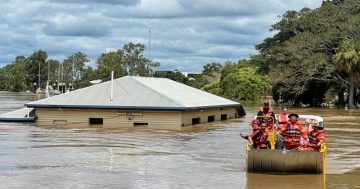
Wujal Wujal residents being evacuated to Cooktown to escape ex-tropical cyclone Jasper in December 2023. Photo: File.
Cape and Torres Strait leaders are beating the drum alongside all the state’s mayors as the Local Government Association of Queensland (LGAQ) ramps up its campaign urging the Federal Government to dump disaster funding changes and better support boots-on-the-ground preparation and recovery.
Concerns already expressed by mayors including Cook Shire Council’s Robyn Holmes and Wujal Wujal’s Alister Gibson have been echoed by Hope Vale Aboriginal Shire Council’s Bruce Gibson, while Lismore Mayor Steve Krieg – whose northern NSW town hit headlines after it was smashed by horrific flooding in 2022 – has also joined the charge.
Some councils even fear a funding shortfall could ultimately lead to the Royal Flying Doctor Service not being able to drop essential supplies to isolated stations and communities in times of need.
The LGAQ contends that Queensland is the most decentralised state and faces more natural disasters than other states and territories.
Concerns relate to the Commonwealth’s proposed Disaster Recovery Framework, which is described as providing states and territories (and ultimately councils) with funding “faster and with less red tape”, while reducing financial risk.
The framework would use standardised assistance packages and a 50/50 funding model (varying somewhat), and accompany a Resilient Infrastructure Scheme “to support communities to build back better after disaster, with funding of up to 15 per cent cost shared with jurisdictions”, according to The National Emergency Management Agency.
It has been slammed as a “disaster of a deal” by Queensland community leaders.
The LGAQ has also spoken out about the the liquidation of Disaster Relief Australia (DRA), which was “increasingly used in place of Australian Defence Force personnel to assist with disaster clean-ups”.
Named Charity of the Year 2023, DRA received $38 million in federal funding for volunteers to help communities prepare and recover from disastrous events such as floods and cyclones. Now, councils wonder who will help in the wake of disasters.
LGAQ chief executive officer Alison Smith said mid-last month that members believed the government should maintain current Disaster Recovery Funding Arrangements (DRFA) as well as commit to more boots on the ground.
Hope Vale’s Mr Gibson said the proposed changes failed to recognise the realities faced by remote communities in one of the most disaster-prone parts of the country.

Hope Vale Aboriginal Shire Council Mayor Bruce Gibson says the changes would leave his community in the lurch. Photo: Supplied.
“The reduction of disaster funding will impact on our community. Food security, just the ability to get around in our community during wet season,” he said.
“It will diminish the access of an economy that is starting to grow and that is the tourism industry. The tourism industry brings vital resources to our town.”
Mr Gibson warned the changes could have far-reaching consequences for his community’s future.
Backing the campaign, Mr Krieg said the changes would be far-reaching and impact many local governments.
“Clearly not a Queensland council, but we all know disasters have no borders and in Lismore, we’re still recovering from one of the biggest disasters in Australia’s history,” he said.
“And this change to DRFA funding is going to have a direct impact on where we go moving forward. We don’t need the changes. We need more investment in disaster recovery, not less.
“And we fully support the Queensland councils in their stand to advocate for more disaster funding, not less.”
The overarching Australian Local Government Association has also called on the government to abandon the proposed changes.
Climate Change Minister Chris Bowen told media the changes were a “fair arrangement” and the government would “work consistently across the board with every state and territory”.
“Every state and territory is exposed to impacts of climate change, not just Queensland,” he said.
Original Article published by Luke Mortimer on Cape York Weekly.