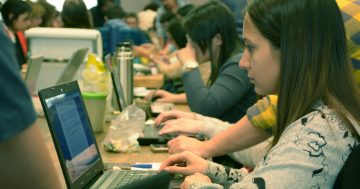
Concerns about students using AI to complete take-home assessments may mean a return to in-class assessments, but not everyone’s convinced. Photo: Michelle Kroll.
As students reach their final years of high school, they could face a return to in-class assessments.
This week, the NSW Education Standards Authority (NESA) began considering a ban on take-home assessments for HSC students.
Fears that students are using artificial intelligence (AI) to complete the assessments are behind the move, with a potential ban to be brought in by the start of term four this year.
NSW Education and Early Learning Minister Prue Car said discussions about the potential ban came alongside a review of AI’s impact on student learning.
“We need to act now as the evidence continues to emerge. It is better to put sensible safeguards in place while we fully understand AI’s long-term impact on student learning,” she said.
“Technology should enhance education, not diminish it. Parents deserve confidence that HSC results reflect a student’s own knowledge, effort and achievement.”
However, for edu-tech lecturer at the University of Canberra Doctor Beth Chapman, a ban on AI won’t cut it.
“Returning to a 1996 assessment model is not going to solve a 2026 problem, in a world where students are expected to use AI,” she told Region.
She called for an approach where governments and schools treated AI like other technologies, with guidelines around appropriate use being established and communicated to students.
She said it would prepare students for a working world where they’ll be expected to be familiar with AI tools (if not use them in their day-to-day roles).
Dr Chapman hit out at the suggestion AI-driven cheating was common among students.
“Students cheat for very particular reasons – it’s very infrequently because they want to do no work and get the top marks.
“It’s what’s going on at home … overwhelmingly when students eventually make a decision to reach to AI, it’s because they feel they have no other choice.”
In the ACT, system moderation days are held twice a year to give schools feedback on academic integrity across their cohorts, while longitudinal mapping is carried out to monitor risk.
Dr Chapman said that while cheating should be condemned, simply focusing on AI use didn’t account for lower-tech methods – like having mum or dad helping with the work.
“Unsupervised take-home assessments have always been vulnerable to academic integrity issues,” she said.
She said teachers can test the “process of the work, rather than the final product” by getting students to complete things like journal entries, drafts or in-progress interviews that show how an assessment has developed.
“Most students want to do the right thing. What’s missing is the scaffolding and guidelines on how to use AI appropriately.”
In its published position on AI use in public schools, the ACT Education Directorate acknowledged the technology (particularly in terms of generative AI) isn’t something just on the horizon.
“The directorate recognises the importance of preparing students to navigate an AI-driven future by developing their knowledge, skills and ethical understanding in this area,” it states.
“Teachers are encouraged to educate students on generative AI … [and] focus on students developing the knowledge, skills and behaviours to understand and apply ethical principles when using AI and other technologies.”
It also said it was committed to modelling responsible use of the technology for both teachers and students.
“The directorate continues to restrict student access to generative AI applications on devices within directorate networks,” the statement said.
“As part of its commitment to duty of care for all its students, the decision to restrict access is due to the lack of reliable safeguards preventing these tools from exposing students to potentially explicit and harmful content.”
An ACT Government spokesperson confirmed it was aware of the interstate push, but didn’t confirm or deny if it was looking at something similar.
The spokesperson also said the ACT’s Board of Senior Secondary Studies was continually monitoring the impact of AI in schools.
“Formal processes exist for tracking academic integrity breaches that result in penalties,” the spokesperson said.
“The number of breaches across the ACT is extremely small with about 0.1 per cent of all assessments having recorded academic integrity issues. These issues include but are not limited to the use of AI.”
Original Article published by Claire Sams on Region Canberra.