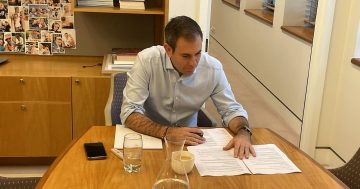
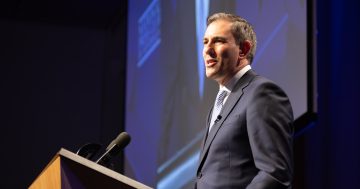
Prime Minister Anthony Albanese and Treasurer Jim Chalmers had to defend the government’s economic credentials during a rowdy Question Time on Wednesday. Photo: Screenshot.
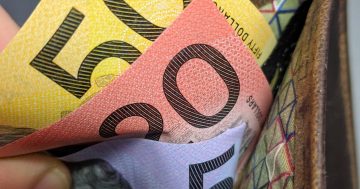
Inflation ticked up to 4.3 per cent in the 12 months to September, up from 4.0 per cent in August.
The Australian Bureau of Statistics (ABS) released the latest Consumer Price Index data on Wednesday (27 October), noting that housing was the largest contributor to annual inflation in September.
“Annual inflation of 5.2 per cent for housing reflected rising costs for both new dwellings and electricity,” ABS head of price statistics Rachael McCririck said.
“New dwelling prices rose 4.7 per cent in the 12 months to September as builders passed on higher costs for materials and labour. This is down from 5.4 per cent in the 12 months to August.”
Transport was the second largest contributor to annual inflation in September, rising by 8.7 per cent, due to higher automotive fuel prices.
“On a monthly basis, automotive fuel prices rose 9.4 per cent in September, compared to a rise of 14.8 per cent in August,” Ms McCririck said.
“This was driven by higher world oil prices.”
Treasurer Jim Chalmers pointed to global economic conditions, particularly the Middle East conflict, as the reason for Australia’s rising inflation.
He said inflation increased in every major advanced economy in September, with international markets expecting rate rises in all of them.
“We’ve seen higher oil prices driving higher inflation around the world and today’s figures confirm we are not immune from that,” Dr Chalmers said.
“From an economic point of view, the conflict can’t end soon enough.
“The numbers in today’s data are still too high.
“Annual inflation has been increasing more in other countries, including by 0.9 percentage points in Italy, 0.8 percentage points in France and 0.4 percentage points in Germany and the UK.
“We know this doesn’t make it any easier for families who are under pressure.
“We recognise people are under pressure and that’s why we are rolling out responsible cost of living relief like cutting income taxes again and boosting bulk billing.
“We are playing our part in the fight against inflation by finding savings.”
But shadow treasurer Tim Wilson described it as a bad day for Australian households.
He said Australians were already “drowning” under higher costs, mortgage rates and paying more for less at supermarkets.
Mr Wilson blamed the inflation spike on out-of-control government spending, saying Labor’s addiction to throwing taxpayers’ money around “consistently dares” the Reserve Bank of Australia to increase interest rates.
“Australians desperately need hope. There will be a lot of households, families sitting around the kitchen tables of the nation trying to figure out what is left to cut,” he said.
“Small business owners will take this inflation data as a kick directly at their future opportunity and their hope.
“The government and its spending addiction continues to fuel Australia’s inflation crisis.
“I know the Treasurer likes to come up with excuses. Well, Australians can’t pay their mortgage with your excuses, Jim.”
Trimmed mean inflation was 3.6 per cent in the year to September. It was 3.5 per cent in the year to August.
In the quarterly data, headline inflation was unchanged at 3.9 per cent through the year to the September quarter.
Trimmed mean inflation was 3.7 per cent through the year to the September quarter, up from 3.6 per cent in the previous quarter.
Inflation dominated debate in a rowdy Question Time on Wednesday afternoon, with Prime Minister Anthony Albanese and Dr Chalmers having to vigorously defend their record and economic credentials.
The ABS figures were released just as RBA Governor Michele Bullock appeared in a Senate Estimates hearing.
Despite the best efforts of Deputy Opposition Leader Jane Hume, the central bank governor would not be drawn on government spending.
Ms Bullock said only that it was the kind of spending that mattered, but stressed she would be making no direct comment on the Federal Government’s budget measures.
Original Article published by Chris Johnson on Region Canberra.