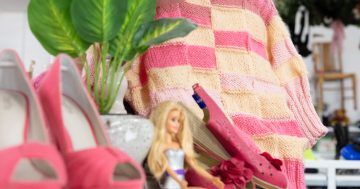
Annika Wells explaining the housing market with Ooshies. Image: Screenshot
Housing approvals have fallen 3.6 per cent, with the Australian Bureau of Statistics releasing data showing the July number for new dwellings slumped to 17,687.
The figures have opened the door for criticism of Labor’s latest tax policies and of one government minister’s wacky attempt to compare the housing crisis to collectible toys.
Private sector housing approvals fell across all states to 10,199 dwellings approved in July, while lower apartment approvals drove the fall in approvals for dwellings other than houses.
Private sector dwellings, excluding houses, fell 0.4 per cent to 7119 in July, 19.9 per cent higher than the July 2025 figure.
Apartment approvals fell 10.1 per cent to 4344 dwellings, 6.8 per cent higher than the average from the past 12 months (4069 dwellings).
ABS head of construction statistics, Daniel Rossi, said that while private-sector houses were down 4.2 per cent, this came off a June that had the most approvals since September 2021.
“In year-on-year terms, the result is 6.0 per cent higher than July 2025,” Mr Rossi said.
Non-residential approvals are driving an overall rise in property values.
The value of total building approvals rose 3.3 per cent to $21.19 billion, after a 1.5 per cent fall in June.
Approved non-residential building rose 14.4 per cent (to $9.93 billion), following a 17.5 per cent drop last month.
The value of total residential buildings fell 4.9 per cent (to $11.26 billion), comprising a 5.0 per cent fall in new residential building (to $9.97 billion) and a 3.9 per cent drop in alterations and additions (to $1.29 billion).
“In chain volume terms, the value of approved total building work was $55.9 billion in the June quarter, the highest level on record,” Mr Rossi said.
In trend terms, approvals for total dwellings varied across the states and territories – Australian Capital Territory (7.4%), Northern Territory (3.4%), New South Wales (2.4%), Queensland (2.1%), and South Australia (0.4%) rose in July, while Victoria (-1.2%), Western Australia (-0.9%), and Tasmania (-0.4%) fell.
Master Builders Australia have put some of the blame for the falling private dwelling figures at the feet of the Federal Government for the tax changes announced in the May budget affecting negative gearing and capital gains.
Chief executive officer Denita Wawn said the challenges facing builders continue to mount, with many in the industry increasingly frustrated that the government keeps talking about housing supply while pursuing policies that make it harder to deliver it.
“The government says it wants more homes, but its recent policy decisions are only producing more frustration in the construction sector,” she said.
“Tradies are feeling that recent government decisions and proposals are making it harder to run a viable small building business.
“Ninety-eight out of every hundred building businesses are small businesses. They are being asked to solve Australia’s housing shortage while Canberra continues to pile on new costs and uncertainty.
“The Federal Government should be backing these businesses through lower costs, greater certainty and stronger investment incentives.
“Instead of doubling down on a pro-supply construction agenda, the government’s tax hiking policies are forecast to reduce housing supply by their own estimates. That is sending exactly the wrong signal at a time when Australia desperately needs more homes.”
Earlier this week, Communications Minister Anika Wells tried to explain the government’s answer to the housing supply by comparing it to the shortage of Ooshies available at Woolworths supermarkets.
In a bizarre video posted on social media, Ms Wells, (who looked like she created the Ooshie shortage by collecting them all herself), said both the collectible toys and the housing market are fuelled by supply and demand.
“The problem right now is the supply of Ooshies and the supply of houses are not keeping pace with demand,” she said, while the late Dolly Parton’s 9 to 5 can be heard playing in the background.
Rightwing think tank the Institute of Public Affairs couldn’t resist the opportunity to take a swipe at Labor.
“It is clear that the Albanese government, far from working 9 to 5 to get more homes through the approvals pipeline, has been sitting on its hands while presiding over record migration numbers which are pushing locals out of housing opportunities,” senior fellow Kevin You said.
“The government has failed to hit every one of its 25 minimum monthly targets to date. If these people were in business, they would have been sacked a long time ago.
“Instead, they keep getting kicked upstairs with more pay, fancier titles, and lamer social media posts.”
Original Article published by Chris Johnson on Region Canberra.