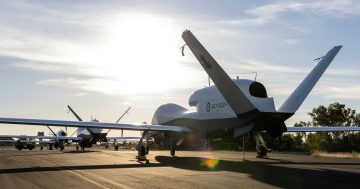
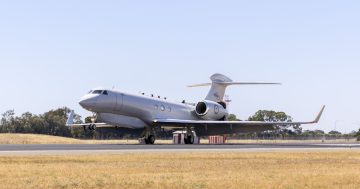
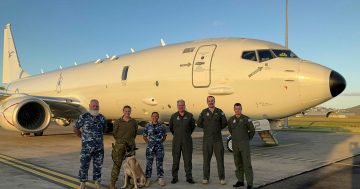
RAAF MQ-4C Triton, P-8A Poseidon, and MC-55A Peregrine aircraft on the ramp at RAAF Tindal. Photo: ADF.
The Royal Australian Air Force has declared an initial operational capability (IOC) for two of the world’s most advanced reconnaissance aircraft.
At a media conference at Edinburgh near Adelaide on Tuesday (22 September), Defence Minister Richard Marles and Chief of Air Force Air Marshal Stephen Chappell said the Gulfstream/L3Harris MC-55A Peregrine and the uncrewed Northrop Grumman MQ-4C Triton had been declared operational.
The declaration of IOC usually comes after a minimum number of aircraft have been delivered, sufficient maintenance and aircrews are in place, aircrew and maintenance training is able to be conducted in Australia, and the aircraft and systems have successfully been deployed and demonstrated their ability to conduct operational missions.
The MC-55A has been ‘seen’ on flight tracker apps in recent weeks conducting electronic intelligence (ELINT) missions around the Philippines and South China Sea where China has asserted its sovereignty over parts of the region in the past decade, none of which is recognised by neighbouring countries nor the United Nations.
Converted from the Gulfstream G550 corporate jet, the MC-55A features several distended bulges and apertures including a long ‘canoe’ fairing under the forward fuselage, numerous other small antennae all around the airframe, and a retractable electro optical/infrared (EO/IR) camera.
The Peregrine has a passive high-altitude, long-range electronic intelligence role, gathering data on adversary land-based, naval and airborne radar and communications systems.
The data gleaned by the aircraft’s onboard systems can be transmitted in real-time, and can be compiled into a data library for Australian and allied combat aircraft so they can better identify, classify, and possibly disrupt these systems if deemed a threat.
The RAAF has ordered four MC-55As, the first of which arrived in Australia in January, and three of which have now been delivered to No. 10 Squadron based at Edinburgh.
The first of four MQ-4C Triton uncrewed maritime surveillance aircraft was delivered to Australia in June 2024, and three aircraft are now in service.
The aircraft themselves along with a combined Air Force and industry maintenance and ground support team are based at RAAF Base Tindal in the Northern Territory, while the pilots, sensor operators and the operating No. 9 Squadron headquarters are located at Edinburgh.

Chief of Air Force AIRMSHL Stephen Chappell talks to media in front of a P-8A (left) and MC-55A at Edinburgh. Photo: ADF.
Being an uncrewed aircraft the size of a 737, the Triton will rarely overfly populated areas, although a much-delayed sense and avoid (SAA) radar is planned to be installed and certified to allow it to operate in controlled airspace in the future.
Based on the Global Hawk, the Triton’s long glider-like wings allow it to fly at altitudes above 55,000 feet for more than 24 hours, giving it the ability to cover vast swathes of ocean in a single mission.
For the maritime role, the Triton has a strengthened airframe, de-icing on the wings and engine inlet, a powerful MFAS radar, maritime modes for the MTS-B EO/IR sensor, and a comprehensive MULTI-INT electronic intelligence system able to listen to and categorise adversary electronic emissions.
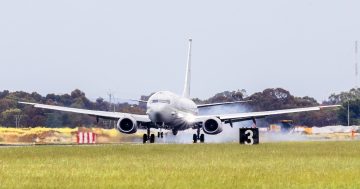
Complementing the Peregrine and Triton milestones was the arrival in Australia of the RAAF’s 14th and final P-8A Poseidon maritime response aircraft, the return of the first Poseidon to be upgraded to the enhanced Increment 3 Block 2 configuration, and the commencement of work in Australia to upgrade the remainder of the fleet.
Mr Marles said the milestones demonstrated the government’s commitment to the RAAF’s air intelligence, surveillance and reconnaissance capabilities.
“South Australia is central to this effort,” he said.
“RAAF Base Edinburgh is becoming one of the most important hubs for advanced Defence capability in the country, supporting our national security and highly skilled Australian jobs.
“The government is investing approximately $5.5 billion over the decade to continue to enhance the ADF’s air intelligence, surveillance and reconnaissance and maritime patrol and response capabilities that will create additional opportunities for Australian industry well into the future.”
AIRMSHL Chappell added, “Our people have been at the heart of delivering the air intelligence, surveillance and reconnaissance capability for Australia, demonstrating exceptional skill, professionalism and dedication in bringing these complex systems into service.
“I congratulate our whole Air Domain team, from across industry, the public service and Air Force for their exceptional work to deliver these cutting edge capabilities for Australia.
“The achievements announced today mark a significant step forward in Air Force capability, delivering persistent, long-range maritime surveillance that strengthens our ability to protect Australia’s interests and deliver highly effective air power as part of the integrated, focused force.”