Senator David Pocock speaking at the release of the Centre for Public Integrity report. Photo: Andrew McLaughlin.
The National Anti-Corruption Commission was a long time in the making, yet it began unravelling almost immediately after its establishment.
It failed on its first big decision not to investigate anyone over the illegal Robodebt scheme. It was subsequently forced into an about-face on that after a public outcry and an inquisition by the organisation’s independent inspector.
It didn’t stop there, though, as conflict-of-interest allegations directed at the very top of the Commission and a string of dubious attempts to explain them saw what little public faith in the institution remained disappear completely.
This is despite the NACC having ploughed through a huge workload of investigations across the public sector, law enforcement and political realms.
To date, it has received 7624 referrals and has completed 92 per cent of its assessments.
There have been numerous court cases (some ongoing) and 11 convictions secured since the Commission began operations three years ago.
And more than 30 investigations are currently open.
Yet the institution’s successes have been all but overshadowed by the perception that things are not quite right at the top.
The terms “conflict of interests”, “paper tiger” and “mates’ rates” shouldn’t be directed towards an integrity institution, but they certainly have been used to describe aspects of the NACC’s operations.
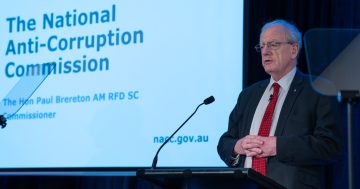
The resignation on Monday (25 May) of inaugural Commissioner Paul Brereton presents an opportunity to reset.
The opportunity, however, is for the Federal Government to grasp.
Brereton will depart in July, and so too will Deputy Commissioner Nicole Rose, who tendered her resignation earlier this month.
The vacancies – most particularly the one left by Commissioner Brereton – must now be filled through an open, merit-based process that allows no room for accusations of impropriety, conflicts of interest or incompetence.
The NACC does not need (and the public does not want) a leadership handpicked from a cast of government mates.
The term “integrity institutions” is interesting.
It includes not only anti-corruption commissions, but auditors-general and ombudsman offices, all of which are charged with overseeing independent scrutiny of public administration, executive power and the use of taxpayers’ money.
On Tuesday morning (26 May), the Centre for Public Integrity used Parliament House to launch its position paper on how these core integrity agencies can be designed to secure both independence and accountability.
Titled Beyond Labels: Securing Functional Independence for Core Integrity Agencies, the report proposes reforms to strengthen these institutions’ ability to hold public power to account.
And it goes right to the heart of what it identifies as the three critical levers that can undermine the independence of integrity agencies if left subject to executive control.
Those levers are funding, appointments and oversight arrangements.
“The appointment of integrity agency heads is critical to institutional effectiveness, independence and public confidence. Leadership determines whether agencies are willing and able to exercise their powers robustly,” the report states.
“Leaders must be chosen in a transparent process and based on merit. If they are not, integrity agencies will be unable to carry out their core mission.
“In fact, the decisions that integrity agency leaders make determines whether their agencies are able to effectively use their powers to expose the misuse of public power or resources by powerful officials.”
Independent MP Helen Haines, who was instrumental in getting the NACC established and forcing its accountability, hosted this morning’s event and was joined by (among others) ACT independent Senator David Pocock and Greens Senator David Shoebridge, who had all been long calling for a change of leadership at the NACC.
“A cloud has hung over the NACC for too long. It’s my hope that the appointment of a new Commissioner – the right Commissioner through a transparent recruitment and appointment process – sets the NACC on a pathway that restores community trust,” Dr Haines said.
“The recruitment and appointment of a new Commissioner and Deputy Commissioner must be clear about how candidates are assessed, and conflicts of interest are declared and managed. This will assist the Parliamentary Joint Committee on the NACC to fulfil its role in reviewing and approving appointments.
“Australians want the NACC to succeed in stamping out corruption. But it still has work to do on transparency, communication, and public confidence if it is to deliver.”
The Centre for Public Integrity’s research director, Gabrielle Appleby, had this to say: “The recent controversies surrounding the NACC demonstrate why integrity agencies themselves need strong integrity safeguards.
“This presents the government with an opportunity to restore public confidence in this important integrity agency by legislating a transparent, merit-based appointments process with independent assessment and meaningful parliamentary oversight.”
Hopefully, the government is listening to all this sound advice and will act appropriately in selecting a new leadership team for the NACC and all other integrity institutions into the future.
Original Article published by Chris Johnson on Region Canberra.