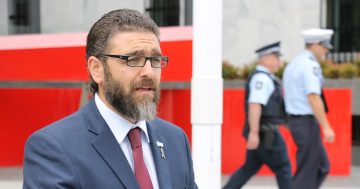
Finance and Public Service Minister Katy Gallagher heralds the formal start to the latest AP wages bargaining process. Photo: Michelle Kroll.
The latest round of APS wage bargaining has formally kicked off, with notices of employee representational rights being sent out to eligible Commonwealth public servants.
With the arrival of the new financial year, Australian Public Service agency bosses have begun issuing the notices in preparation for talks to begin later this month.
The parties will have seven months to reach an agreement, but it won’t be easy.
The government will have to deal with nine unions representing almost 200,000 employees across 108 agencies.
And for the first time, non-APS agencies – those not covered by the Australian Public Service Act – will be able to opt in.
The National Gallery of Australia has already said yes to that, with at least three other non-APS public sector entities close to deciding whether to also sign up to the so-called “pattern bargaining”.
The Australian Public Service Commission’s bargaining team, led by chief negotiator Alison Stott and her deputy Damien Booth, is confident of success, stressing that nothing is non-negotiable and all bargaining will be conducted in good faith.
“Bargaining matters because it shapes pay and conditions that affect your working life every day,” Ms Stott told APS staff in a video message.
“In this round we are guided by clear principles – being a model employer; building a more unified, capable and modern APS; supporting workforce attraction, development and retention; improving productivity and efficiency; and delivering outcomes that are fair, equitable and sustainable.”
But Finance and Public Service Minister Katy Gallagher has already played down the Community and Public Sector Union’s ambit 15 per cent over three years pay claim, which won the support of 80 per cent of the union’s voting members.
She told a recent Senate Estimates hearing that the claim had not yet been submitted to her and that it would be “highly unusual” to preempt the outcome at this stage.
But she added that the outcome had to be manageable and affordable and suggested that it would be impossible to agree to the CPSU’s claim.
On Thursday (2 July), Senator Gallagher said bargaining will be guided by the Federal Government’s Public Sector Workplace Relations Policy 2026, which supports a “model employer” approach and a “unified, capable and contemporary” APS.
She said the policy provides a framework for fair, sustainable and productive workplace arrangements that support employee attraction, development, mobility and retention, while promoting fairness, equity and administrative efficiency.
“APS-wide bargaining is about delivering fair, consistent conditions for public servants while supporting a strong, capable and modern public service,” the minister said.
“This next round of bargaining is another opportunity to build on the progress already made, continue improving commonality in pay and conditions, and support the APS to be the model employer it should be.
“Public servants do important work every day for the Australian community. The Albanese Government will continue to engage constructively to support fair, practical and sustainable outcomes across the APS.”
That doesn’t mean for a moment that it will be an easy ride for any of the parties.
The Taxation Officers’ branch of the Australian Services Union has already let Senator Gallagher know they’re not up for a similar blanket coverage deal for all public servants, similar to the last bargaining round.
That round resulted in an 11.2 per cent APS-wide pay increase over three years and 59 common conditions.
Employees received a 4 per cent pay rise from December 2023, followed by a 3.8 per cent rise in 2024 and a further 3.4 per cent increase the following year.
The APSC and the minister have indicated that, while the new round won’t go backwards, negotiations are likely to depart from the last bargaining round and its outcome.
They said this round will continue the work of improving commonality in pay and conditions across the APS over time, while recognising that agencies have different operating environments.
Bargaining will occur in two parts.
First, Part A will focus on common conditions that may apply across the APS.
This will be followed up at the “appropriate stage” with Part B of agency-level bargaining, enabling agencies to negotiate terms that support their specific operational needs.
CPSU national secretary Melissa Donnelly welcomed the formal release of the Notices of Employee Representational Rights, and said her union was keen to “get on with the task” of bargaining for improved pay and conditions.
“Public sector employees are facing real cost of living pressures and that’s why we are seeking 5 per cent per annum or CPI – whichever is higher – as well as better work life balance for APS workers including consolidation of ground-breaking flexible work rights, stronger protections around AI, paid leave, and career development with guaranteed learning and development time,” she said.
“The CPSU has been ready and willing to commence negotiations since April, and we’re pleased we can now finally get on with the bargaining process.”
Original Article published by Chris Johnson on Region Canberra.