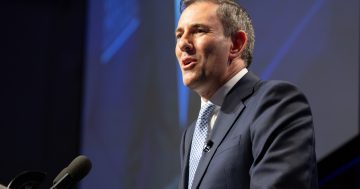
Environmental science research is getting the most funding, but growth in government spending on overall R&D has slowed. Photo: Canberra Convention Bureau.
Government spending on research and development has seen the slowest growth in six years and has declined in real terms, according to newly released data from the Australian Bureau of Statistics.
In 2024-25, government spending on R&D was $4.4 billion, up 1 per cent from 2022-23, but the growth rate is the lowest since 2018-19.
Government spending on R&D as a proportion of GDP fell from 0.17 per cent in 2022-23 to 0.16 per cent in 2024-25.
ABS head of business statistics, Tom Lay, said that, when adjusted for inflation, government spending on R&D declined by 4 per cent in real terms in 2024-25.
“This 1 per cent increase in government R&D expenditure is the lowest since 2018-19, when it grew 2 per cent,” he said.
The largest decreases in R&D expenditure by field of research were in information and computing sciences, down $112 million (25 per cent), and in agricultural, veterinary and food sciences, down $67 million (11 per cent).
Commonwealth government expenditure on R&D fell by 1 per cent (to $2.8 billion) while state and territory spending rose by 3 per cent (to $1.6 billion).
“At the Commonwealth level, R&D spending focused mainly on defence and environmental management,” Mr Lay said.
“At the state and territory level, R&D spending was directed mainly toward health.”
Environmental sciences, however, recorded the largest dollar rise in R&D expenditure by fields of research, up $224 million (55 per cent).
This makes environmental sciences the leading field of research for government organisations, ahead of biomedical and clinical sciences, which rose $78 million (14 per cent).
Mr Lay said growth in this area aligns with government investment to promote renewable technologies aimed at reducing carbon emissions under the Net Zero Plan.
Between 2022-23 and 2024-25, four states or territories recorded increases in their Government Expenditure on Research and Development-Gross State Product ratios.
The Australian Capital Territory recorded the largest decrease, down 0.15 percentage points, while Tasmania recorded the largest increase, up 0.09 percentage points.
In 2024-25, expenditure on R&D by Australian government organisations was $4379 million, up $35 million from 2022-23.
Over the same timeframe, expenditure on R&D performed by Australian private non-profit organisations was $1691 million, up $96 million from 2022-23.
In other ABS data released this week, the total value of the nation’s residential dwellings rose by $315.9 billion, or 2.5 per cent, to $12.8 trillion in the March quarter 2026.
ABS head of finance statistics Mish Tan said growth in dwelling values moderated over the quarter, following a strong rise in late 2025.
“Despite this, the value of Australia’s dwelling stock is 11.9 per cent higher than a year ago, with increases in residential property prices continuing to drive growth,” Dr Tan said.
The mean price of residential dwellings in New South Wales ($1,324,800) remains the highest in the country, followed by Queensland ($1,123,700) and Western Australia ($1,103,500).
The mean price in the ACT rose slightly to $1,018,000.
The Northern Territory maintains the lowest mean price at $597,300.
Victoria was the only state or territory to see a fall in the mean price of residential dwellings this quarter (-0.3 per cent or -$2400).
Western Australia (7.2 per cent, or $73,700) and Queensland (4.6 per cent, or $49,800) recorded the strongest rises.
“Price growth has been strongest in Western Australia, the Northern Territory and Queensland over the past year,” Dr Tan said.
“Annual growth for these states is well above New South Wales and Victoria, where increases have been comparatively modest.”
Original Article published by Chris Johnson on Region Canberra.