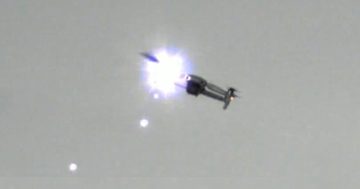
The funding increases are likely to include more drones and counter-drone systems for the ADF. Photo: ADF.
The Federal Government says it will increase defence spending by a further $53 billion over the next decade as it strives to reach a target of 3 per cent spending as a proportion of GDP.
While the details of how that money will be spent won’t be released until Defence Minister Richard Marles releases the 2026 National Defence Strategy (NDS) at the National Press Club on Thursday afternoon (16 April), the government says it will increase spending to bring Australia into line with NATO countries that are also aiming for the notional 3 per cent target.
Over the forward estimates to 2030, an additional $14 billion will be added to the Defence budget, while an additional $53 billion will be added out to 2036.
This increase will mean total spending on Defence over the next decade will top out at $887 billion, of which $425 billion will be allocated to funding for capabilities that will be laid out in the 2026 Integrated Investment Plan (IIP) which will also be released on Thursday afternoon – a $95 billion increase from that allocated in the 2024 IIP.
The government says that most of the new funding will be allocated to capabilities designed to deter and respond to current and emerging threats as have been proliferating in recent conflicts. These include low-cost swarming airborne and ocean-going drones, cyber threats, and hypersonic and ballistic missiles.
It will also be spent on capabilities that will see the Australian Defence Force become more self-reliant in the event of conflict, and on investments in preparedness and resilience to ensure the ADF is “postured” and ready for potential near-future threats or conflicts.
While it is unlikely new big-ticket items such as additional aircraft, ships or submarines will be acquired, the additional investment can be expected to be directed towards uncrewed airborne, ocean-going and underwater systems (UAS, UMS, AUV) – as was flagged by Mr Marles and Defence Industry Minister Pat Conroy earlier this week, counter-UAS systems, integrated air defence systems (IADS), greater numbers of missiles stocks, more resilient base infrastructure, a possible resurrection of sovereign space-based capability projects, and an acceleration of the government’s ambitions to manufacture guided weapons in Australia.
Rather than being a departure from the direction laid out in the 2024 NDS, the government says it is a strengthening of resolve with an increased focus on self-reliance.
Some of the new investment will be sourced through what the government has described as “alternative financing”.
It says the 2026 NDS acknowledges the need to leverage all forms of investment and financing to deliver capabilities at the scale and pace required, including equity-based financing through Commonwealth bodies such as specialist direct investment vehicles and government business enterprises, as well as private financing.
It says that, where appropriate, alternative financing can present advantages in delivery models by accessing private sector expertise and supporting Australia’s defence industrial base while maintaining responsible budget management.
As with all defence documents from the past decade, the 2026 NDS is expected to once again point out that Australia faces its most complex and threatening strategic circumstances since the Second World War, although with recent events in Iran and the wider Middle East region, this appears to finally be closer to fact than fiction.
Once dependable alliances are now less certain, while the proliferation and rapid development of asymmetric warfare capabilities and tactics makes it more difficult to predict where the next threats will come from, let alone defend against them.
The additional funding will be reflected in May’s Federal Budget which, in a flagging domestic and global economy, will likely see some other big ticket items cut.