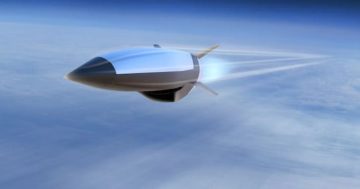
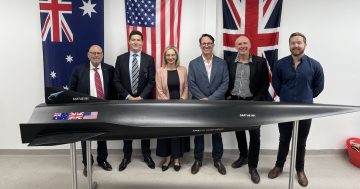
Concept art of the jointly-developed HACM hypersonic missile. Photo: Raytheon.
The US Air Force and Royal Australian Air Force have reportedly conducted the first test flight of a hypersonic attack missile.
The Hypersonic Attack Cruise Missile (HACM) is a scramjet-powered two-stage missile capable of being air launched and flying to and striking a target at more than five times the speed of sound.
Manufactured by RTX (Raytheon) and Northrop Grumman, HACM has been developed from the joint US – Australian Southern Cross Integrated Flight Research Experiment (SCIFiRE) program, a 15-year collaborative agreement to develop and test hypersonic cruise missile prototypes and to conduct research into hypersonic scramjets, rocket motors, sensors, and advanced manufacturing materials.
Hypersonic air-breathing missiles can travel hundreds of kilometres in just minutes, and can be manoeuvred to make interception difficult. The missile is propelled to near-hypersonic speeds using a booster rocket, before the scramjet takes over.
Unlike conventional jet engines, scramjets have fewer or no moving parts, and instead provide combustion and compression of the supersonic airflow through a chamber to sustain high-speed flight.
But the HACM and other US hypersonic programs have suffered from developmental and funding delays in recent years.
A 2024 US Government Accountability Office (GAO) report – the US equivalent to the Australian National Audit Office (ANAO) – highlighted ongoing schedule risk to a number of test and development programs due to a lack of resources within the US Department of Defense.
The GAO report highlighted a lack of test range availability as a limitation for the testing of hypersonic programs.
“To alleviate this issue, the HACM program is integrated with the Southern Cross Integrated Flight Research Experiment [SCIFiRE], a joint US Australian effort,” the GAO said.

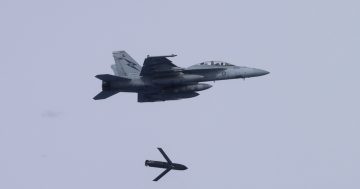
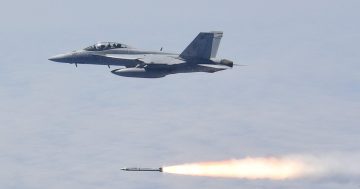
RAAF F/A-18F Super Hornets have recently been involved in test programs of new strike and air-to-air weapons. Photo: CPL Ryan Howell, ADF.
The US has several major weapons test ranges dotted around its coastline and in the south-western states of Nevada and New Mexico, but none with the same space, remoteness and lack of airspace restrictions as Woomera in South Australia, or the Delamere and Bradshaw ranges in the Northern Territory.
“Through this joint effort, several of HACM’s planned flight tests will occur in Australia using Australian Air Force F/A-18s,” it said.
It has now been reported that the test was carried out on an Australian test range, and that the US Air Force said it hoped to start rapidly acquiring HACMs in 2027.
With the implementation of the AUKUS construct – in particular the Pillar 2 elements which include joint development and exploitation of hypersonic technologies – there are now fewer export and security restrictions on the US in releasing or sharing these technologies with Australia.
“The US Air Force, in partnership with Australia, has conducted a flight test of the Hypersonic Attack Cruise Missile (HACM) as part of our continuous work to advance long-range strike capabilities,” a US Air Force spokesperson told US online publication TWZ on 5 October.
“This effort is part of the Southern Cross Integrated Flight Research Experiment (SCIFiRE), a collaborative agreement built on more than 15 years of partnership between our two nations.”
The statement didn’t elaborate on what date the test flight took place, what range it was conducted over, whether it achieved hypersonic speeds, nor what aircraft the missile was launched from. But it did confirm it was an RAAF aircraft, so based on previous reporting and government statements, it was likely a Boeing F/A-18F Super Hornet.
“Leveraging this enduring alliance, the Royal Australian Air Force executed the release of a HACM flight test unit over a designated Australian test range, gathering crucial data to advance the program’s objectives,” the spokesperson added.
“The flight was the culmination of an extensive series of tests designed to measure the missile’s performance under realistic flight conditions.”
The RAAF has recently inducted the new AGM-158C LRASM into service on the F/A-18F, and has also been involved in recent exercises in California where RAAF F/A-18Fs have been seen carrying the new AIM-260 JATM air-to-air missile.