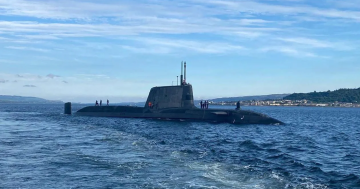
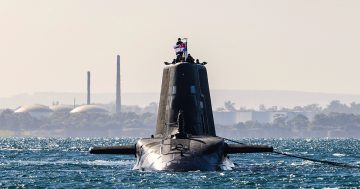
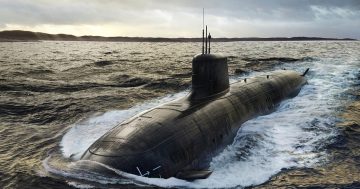
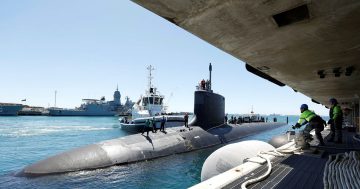
USS Colorado arrives at HMAS Stirling on 27 October. Photo: SMNIS Shelby Allan, ADF.
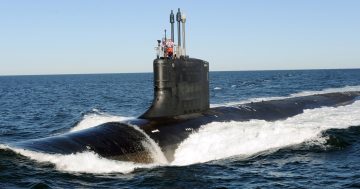
The US, the UK and Australia have jointly announced that a US Navy Virginia-class nuclear-powered fast attack submarine (SSN) will be the first boat to deploy to HMAS Stirling in WA for Submarine Rotational Force — West (SRF-West) from late 2027.
A key tenet of the AUKUS Pillar I agreement between the three nations, SRF-West will see US and UK SSNs forward-deployed to HMAS Stirling as part of a plan to boost submarine presence in the Indo-Pacific region, with the USS Colorado (SSN 788) to be the first.
Currently, US submarines deploy from Hawaii, Japan or Guam, whereas the UK has no submarine bases in the Indian or Pacific oceans.
As part of the plan to host the SSNs, HMAS Stirling and the nearby Henderson Naval Precinct are undergoing upgrades so that maintenance and resupply of the boats can be safely and reliably conducted far from home.
It is planned that up to four US SSNs and one from the UK will be forward-deployed to HMAS Stirling on a rotational basis, in addition to the first of up to five Virginia-class boats the Royal Australian Navy (RAN) intends to accept from 2032.
Australia’s ability to host SRF-West is designed to accelerate its own readiness to operate, maintain and regulate a sovereign, conventionally armed SSN capability, and support AUKUS partners’ SSN deployments by expanding maintenance options and sustainment infrastructure in the region.
Additional preparation has seen the RAN place engineering staff in US and UK nuclear power training schools, and exchange deployments aboard US and UK SSNs. Australian industry has also placed growing numbers of engineering staff on secondment at the Pearl Harbor Naval Shipyard and Intermediate Maintenance Facility in Hawaii, where they are embedded with the US Navy’s SSN sustainment workforce.
It has previously been announced that the RAN will take three former US Navy Virginia-class Block IV boats, but only if the US President of the day releases them from US Navy stocks. Currently, US Navy SSN production continues to run at a rate of fewer than 1.3 boats a year, well below the planned 2.3 boats it needs to be building to meet its own operational needs.
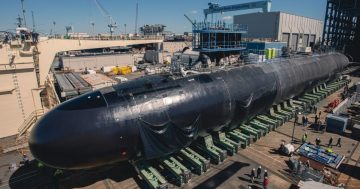
Plans to increase SSN production with the building of a new shipyard in Baltimore, Maryland, to add to the two existing yards in Groton, Connecticut, and Newport News, Virginia, are unlikely to boost production sufficiently in time for the decision to release the boats.
Despite questions being raised about Australia’s sovereignty over visiting SSNs, the government insists SRF-West has been established at Australia’s invitation and will operate in accordance with relevant international agreements between and among the US, Australia and the UK, including the United States–Australia Force Posture Agreement.
It says AUKUS activities associated with SRF-West will be conducted consistent with the AUKUS partners’ respective international obligations, including those under the Treaty on the Non-Proliferation of Nuclear Weapons, and Australia’s obligations under the South Pacific Nuclear Free Zone Treaty of Rarotonga.
In a 26 October statement, US Representative Joe Courtney, whose district covers the Groton shipyard, praised the announcement.
“The combination of US and UK attack submarine rotations and Australian nuclear-powered submarines will transform allied naval posture in the Indo-Pacific,” he said.
“AUKUS Pillars I and II continue full steam ahead with [the US] Congress and the navy in lockstep with the UK and Australia.”
The naming of USS Colorado to be the first SRF-West deployment coincides with that boat’s arrival in WA on 27 October for a programmed Submarine Maintenance Period.
During the boat’s visit, it will receive hull maintenance work including the replacement of the thin line towed sonar array, and other repairs. Australian and US Navy personnel will install sail maintenance scaffolding, and will also conduct simulated radiological scenarios that exercise radiation safety practices and procedures.
The Director General of the Australian Submarine Agency, Vice Admiral Jonathan Mead said the USS Colorado‘s visit will be the fourth submarine maintenance period to be conducted at HMAS Stirling.
“Since the previous maintenance activity on a US Virginia-class submarine in late 2025, Australia has worked with our AUKUS partners to grow our workforce, upgrade infrastructure at HMAS Stirling, strengthen regulatory frameworks, and welcome the first US personnel to Western Australia,” he said.
“This SMP is helping develop the skilled workforce needed to support Australia’s future submarine capability. It will create opportunities for Australian industry, supporting local jobs, businesses and economic growth.
“This port visit doesn’t just support routine maintenance efforts for a US submarine. It demonstrates Australian sovereign industrial capability and the progress being made towards SRF-West and the delivery of AUKUS.”