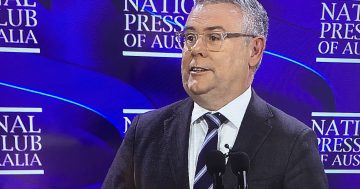
Prime Minister Anthony Albanese has unveiled a plan to help fast-track environmental approvals. Photo: Thomas Lucraft.
The Federal Government will pour in more than $45 million over four years to reach bilateral agreements with the states and territories that help speed up environmental approvals for development projects.
The plan aims to remove the current two-step process and simplify applications by reducing duplication.
It follows recent reform to the Environment Protection and Biodiversity Conservation Act that established new National Environmental Standards.
Anthony Albanese announced his intentions during a landmark speech to the WA Chamber of Minerals and Energy on Wednesday (29 April).
The Prime Minister said his address would be the “largest speech” he gave in the lead up to the federal budget on 12 May, which he added would be the government’s “most important” and “most ambitious” budget to date.
He said the new $45 million investment would encourage state and territory governments to prioritise progressing and signing new assessment and approval bilateral agreements with the Commonwealth.
State and territory governments who signed a new bilateral assessment or approval agreement with the Federal Government would be empowered to conduct assessments or approvals on the Commonwealth’s behalf, subject to new National Environmental Standards.
The PM said this would fast-track new energy, housing and resources projects by combining federal and state assessments and approvals, reducing duplication in the assessment and approval process.
“Twenty years ago, the median approval time for a project under the EPBC Act was 48 weeks,” Mr Albanese said.
“When we brought our reforms into parliament, the median timeframe had blown out to 118 weeks.
“Too often, that means investors simply walk away, communities miss out on jobs and people miss out on new energy or housing.
“We took action to fix this – and we are building on it today … committing over $45 million to speed up and simplify approvals into a single-touch process.”
The Prime Minister said the investment would fast-track new energy, housing and resources by effectively removing an entire layer of bureaucracy from the process.
And strong environmental safeguards would remain in place with projects required to meet the Commonwealth’s environmental standards.
All bilateral agreements would be subject to assurance by the new National Environmental Protection Agency, which starts operations on 1 July this year.
“So instead of a two-stage, two-track process and with that all the cost of delays and doubling up, this will be a one-step process, with one, clearer, faster, yes or no,” he said.
“After too many wasted years, this can be a circuit breaker – if the states step up and sign up.”
The WA Government has already stepped forward and is the first state to sign a bilateral agreement with the Commonwealth over environmental approvals.
“The landmark reforms we passed late last year are vital to protect our environment and to boost productivity in our economy,” Mr Albanese said.
“We strongly encourage state and territory governments to step up and sign up to a new bilateral agreement, to deliver a system that cuts red tape and duplication and delivers environmental laws that are clear and consistent.
“This investment will ensure the full benefits of the reforms can be realised as soon as possible.”
Federal Environment Minister Murray Watt said the government was committed to delivering stronger environmental protections and faster decision-making.
“The best way to speed that up is for state and territory governments to sign up to a new and improved bilateral agreement and this funding will ensure we can enter better and more enduring agreements sooner,” he said.
“We’re deeply committed to ensuring our national environmental laws are fit for purpose and we expect state and territory governments to work with us to achieve this important outcome.”
It took until the very last day of the parliamentary sitting year last year, but the Federal Government got its overhaul of Australia’s environmental protection laws over the line, following a deal struck between Labor and the Greens.
Negotiations cut the Coalition out of play altogether.
The new laws establish a national environment protection agency and require development projects to report carbon emissions, but specifically rules out a climate trigger that would prevent projects from going ahead.
They also allow for no-go zones where projects can be denied before applications are progressed.
To secure the bill’s successful passage through the Senate, the government had to agree to include native forest logging in national environment standards within 18 months; set up a $300 million support fund for the forestry industry; and remove any sunset exemptions from the legislation for high-risk land-clearing and regional forestry agreements.
Original Article published by Chris Johnson on Region Canberra.